
The Friction Report - BLOG
The Friction Report is a running dispatch from the front line of human avoidance.
No motivation sermons. No soft-focus coping.
Just clear thinking, practical cuts, and the small daily moves that make self-deception unemployed.
Click below to Access the Reports
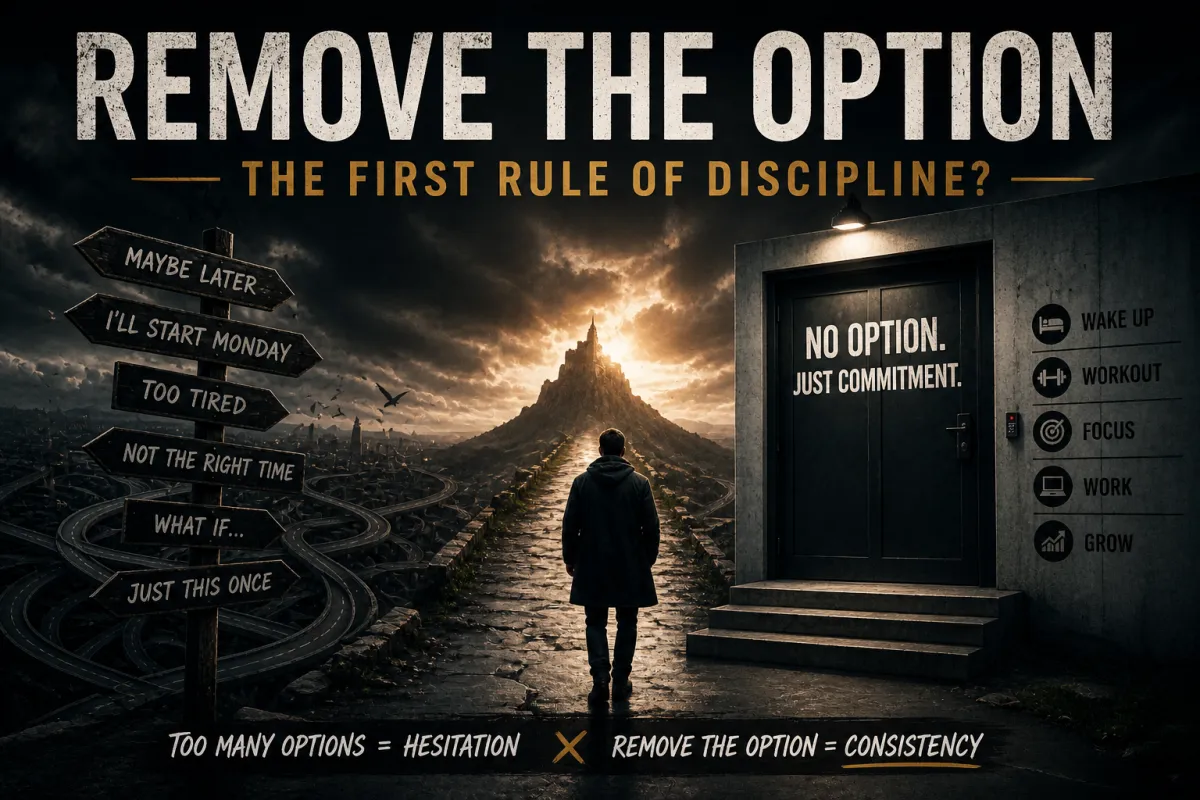
Remove the Option | The First Rule of Discipline
There is a moment before every meaningful action where a quiet negotiation begins.
You feel it.
You sit down to work.
You consider going to the gym.
You think about having the difficult conversation.
And then something opens up:
A choice.
You could do it.
Or you could delay.
Or you could soften it.
Or you could come back to it later.
This moment feels small.
It isn’t.
It’s where most outcomes are decided.
The Myth of Choice
We tend to think that having more choice is a good thing.
More freedom. More flexibility. More control.
But when it comes to behaviour, too much choice creates instability.
Because every time you re-open the question — “Should I do this?” — you introduce friction.
And friction, as you now understand, rarely favours effort.
It favours ease.
Where Discipline Actually Breaks
Discipline does not usually break in the middle of action.
It breaks at the start.
At the moment of decision.
Before you begin.
Because once you start, momentum can carry you.
But before you start, everything is negotiable.
And negotiation is where comfort wins.
The Cost of Keeping the Option Open
If every action is optional, then every action competes.
Work competes with distraction.
Training competes with rest.
Focus competes with comfort.
And comfort is always easier to choose.
Not because you are weak.
Because it requires less energy, less resistance, and less commitment.
So when you keep the option open, you are not being flexible.
You are creating a system where the easiest path wins.
The Principle
The first rule of discipline is simple:
Remove the option.
Not emotionally.
Structurally.
Make the decision once, in advance.
And then eliminate the need to decide again.
What This Looks Like
Instead of:
“I’ll work out if I feel like it.”
You decide:
“I train at 7am.”
Not as a preference.
As a rule.
Instead of:
“I’ll start when I’m ready.”
You decide:
“I start at 9.”
Again, not a suggestion.
A commitment.
The difference is subtle.
But the effect is enormous.
Why This Works
When the option is removed, something changes.
You no longer ask:
“Do I feel like doing this?”
You ask:
“When does it start?”
The decision is no longer emotional.
It is procedural.
And procedures are easier to follow than intentions.
The Role of Pre-Commitment
The real work happens before the moment.
When you are clear.
When you are calm.
When you are not under pressure.
That is when you decide.
You set the time.
You prepare the environment.
You reduce the friction.
So that when the moment arrives, there is nothing left to negotiate.
The Environment Enforces the Rule
This is where the Friction Triangle becomes practical.
You don’t rely on willpower.
You change the environment.
If you want to train in the morning:
your clothes are ready
your alarm is set
your path is clear
If you want to work:
your space is prepared
your distractions are removed
your tools are available
The environment says:
“This is happening.”
The Discomfort of Commitment
Removing the option feels restrictive.
At first.
Because it removes escape routes.
You can’t delay.
You can’t soften it.
You can’t talk yourself out of it.
That discomfort is not a problem.
It’s the point.
Because that is the exact space where growth begins.
The Common Objection
“What if I don’t feel like it?”
You won’t.
That’s why the rule exists.
If you only act when you feel like it, you will only act when conditions are easy.
And when conditions are easy, growth is limited.
The Second Objection
“What if I fail?”
You will.
At some point.
But failure inside a system is different from failure without one.
Inside a system, failure is an interruption.
Outside a system, failure becomes identity.
The Power of Repetition
When you remove the option consistently, something changes.
The behaviour becomes normal.
Not easy.
But expected.
You stop debating it.
You stop analysing it.
You simply do it.
The Identity Shift
Over time, the question disappears.
You don’t ask:
“Should I do this?”
You become:
“The kind of person who does this.”
And identity is far more stable than motivation.
Where to Start
Do not apply this everywhere.
That is another form of overreach.
Choose one area.
One behaviour.
One non-negotiable.
It might be:
starting work at a fixed time
training three times a week
removing your phone during focus blocks
Make it specific.
Make it clear.
Make it unavoidable.
The First Rule
Once you choose it, protect it.
Do not renegotiate daily.
Do not adjust based on mood.
Do not weaken it when it becomes uncomfortable.
That is the moment it matters most.
The Quiet Result
At first, it feels forced.
Then it feels structured.
Then it feels normal.
And eventually, it feels like you.
Not because you changed your personality.
Because you changed your system.
What Comes Next
Removing the option creates action.
But action needs direction.
You need a way to apply this across multiple areas.
In a controlled, deliberate way.
→ Enter: The Anti-Comfort Protocol
→ Revisit: The Friction Triangle
→ Measure: The Comfort Audit
You don’t need more motivation.
You need fewer decisions.
Because every decision is a chance to escape.
And every escape delays the life you are trying to build.
https://www.rebelphilosopher.co.uk/blog/b/comfort-as-religion
https://www.rebelphilosopher.co.uk/blog/b/why-comfort-feels-right
https://www.rebelphilosopher.co.uk/blog/b/comfort-loop
https://www.rebelphilosopher.co.uk/blog/b/you-are-not-lazy
https://www.rebelphilosopher.co.uk/blog/b/friction-triangle

Pending Reports...
Friction Isn’t a Sign to Stop. It’s the Door Handle.
Due Date June
Friction: Resistance shows up, you interpret it as danger.
Cause: Your nervous system confuses growth with threat.
Cut: Name the sensation (“tight chest”, “buzzing”, “dread”) and proceed anyway—slowly.
Proof: 5 “did it while uneasy” wins recorded.
The Two-Minute Betrayal
Due Date June 2026
Friction: You lose the day in tiny detours.
Cause: Micro-avoidance compounds into macro-failure.
Cut: Before any “quick check”, do one action toward the main task.
Proof: 10 consecutive “first move” wins.
Busy Is Not Productive (It’s Often Just Polite Panic)
Due Date June 2026
Friction: Your calendar looks full; your life looks unchanged.
Cause: Activity soothes anxiety without producing outcomes.
Cut: Choose one measurable weekly outcome and block the work first.
Proof: Outcome completed before Friday each week.
The Identity Trap: ‘That’s Not Me’
Due Date July 2026
Friction: You avoid actions that threaten your self-image.
Cause: The ego protects the story more than the future.
Cut: Act as the person you want to be for 5 minutes. Identity follows behaviour, not speeches.
Proof: A growing list of “I did the thing” evidence.
The Proof-of-Work Life
Due Date July
Friction: You want confidence without receipts.
Cause: You confuse thinking-about-it with building-it.
Cut: Build a “Proof Folder”: screenshots, logs, drafts, reps, shipped links.
Proof: 30 artifacts in 30 days.