
The Friction Report - BLOG
The Friction Report is a running dispatch from the front line of human avoidance.
No motivation sermons. No soft-focus coping.
Just clear thinking, practical cuts, and the small daily moves that make self-deception unemployed.
Click below to Access the Reports
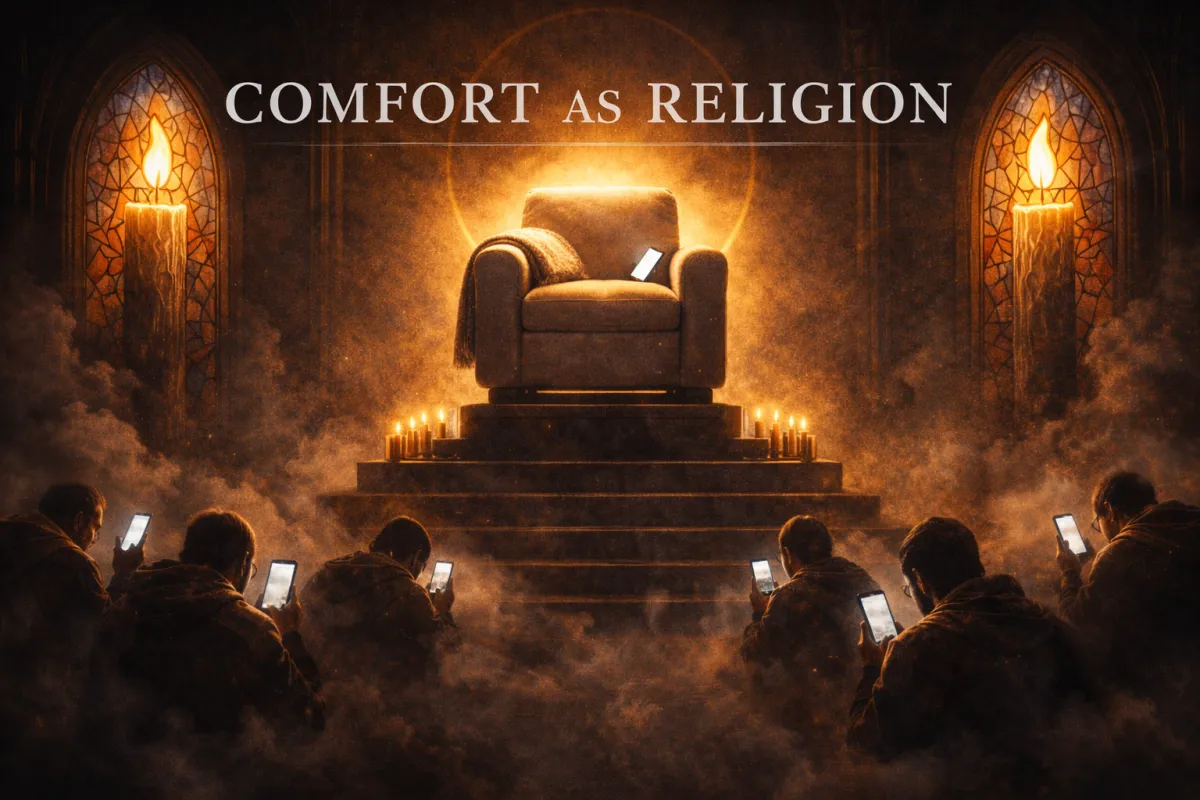
Comfort as Religion
We live in the most comfortable civilisation in human history.
Food arrives at our door. Entertainment streams endlessly. Climate bends to a thermostat.
And yet anxiety has never been higher.
Somewhere along the way, comfort stopped being a luxury — and became a belief system.
There was a time when men built cathedrals to worship God.
Now we build climate control.
There was a time when people feared judgment after death.
Now we fear mild inconvenience before lunch.
Comfort is no longer a preference.
It is doctrine.
And like all religions, it has commandments.
Thou shalt not be uncomfortable.
Thou shalt avoid friction.
Thou shalt optimise for ease.
Break these, and you are cast out — not from heaven — but from the algorithm.
The New God
Comfort does not shout. It hums.
It whispers:
“You deserve this.”
“You’ve had a long day.”
“Start tomorrow.”
“Why strain? There’s a shortcut.”
It promises relief.
It delivers stagnation.
We used to fast to strengthen the spirit.
Now we snack to silence it.
We used to walk miles for water.
Now we order it with a thumb twitch.
We used to endure boredom and discover thought.
Now boredom lasts 4.7 seconds before we swipe it away.
Comfort has not made us evil.
It has made us soft.
And softness, when worshipped, becomes decay.
And here’s the irony.
In the same decades that convenience has exploded — same-day delivery, streaming on demand, food at a tap, climate-controlled everything — anxiety has not declined.
In the UK, rates of reported anxiety disorders have risen sharply over the past 10–15 years, particularly among young adults. In the U.S., surveys show adults reporting symptoms of anxiety at levels significantly higher than pre-2010 baselines. At the same time, our lives have become measurably more frictionless than any generation in history.
More convenience.
More comfort.
More reported anxiety.
If comfort were the cure, the curve would bend the other way.
And isn’t that the real twist?
We engineered a world to eliminate friction.
Then wondered why we felt fragile.
Rituals of the Faithful
Every religion has rituals.
The Ritual of Scrolling.
The Ritual of “Just One More Episode.”
The Ritual of Saying Yes When You Mean No.
The Ritual of Saying Tomorrow When You Mean Never.
You wake.
You reach for the glowing rectangle.
You kneel to the feed.
Morning prayer.
We laugh, but tell me:
How many mornings begin with silence?
How many begin with self-direction rather than digital instruction?
Comfort thrives in unconscious repetition.
It doesn’t need chains.
It needs habits.
The Theology of Avoidance
Comfort’s central belief is this:
Discomfort is danger.
It is not.
Discomfort is data.
The shaking voice before speaking truth.
The resistance before the workout.
The tension before ending what should have ended long ago.
Growth feels like loss before it feels like gain.
The problem is not that we feel discomfort.
The problem is we interpret it as a sign to retreat.
So we medicate it.
Scroll it.
Eat it.
Rationalise it.
And then we call that “self-care.”
There is real self-care.
And then there is self-sedation wearing a yoga mat.
The Priesthood
Every religion has priests.
In the Church of Comfort, the priests are subtle.
The endless stream of “you deserve ease.”
The industries built on removing friction.
The cultural narratives that equate struggle with failure.
Struggle used to mean you were alive.
Now it means you’re “not aligned.”
Alignment, apparently, feels like a mattress.
But look at anything magnificent —
Strength, mastery, character, leadership.
It was forged.
And forging is not gentle.
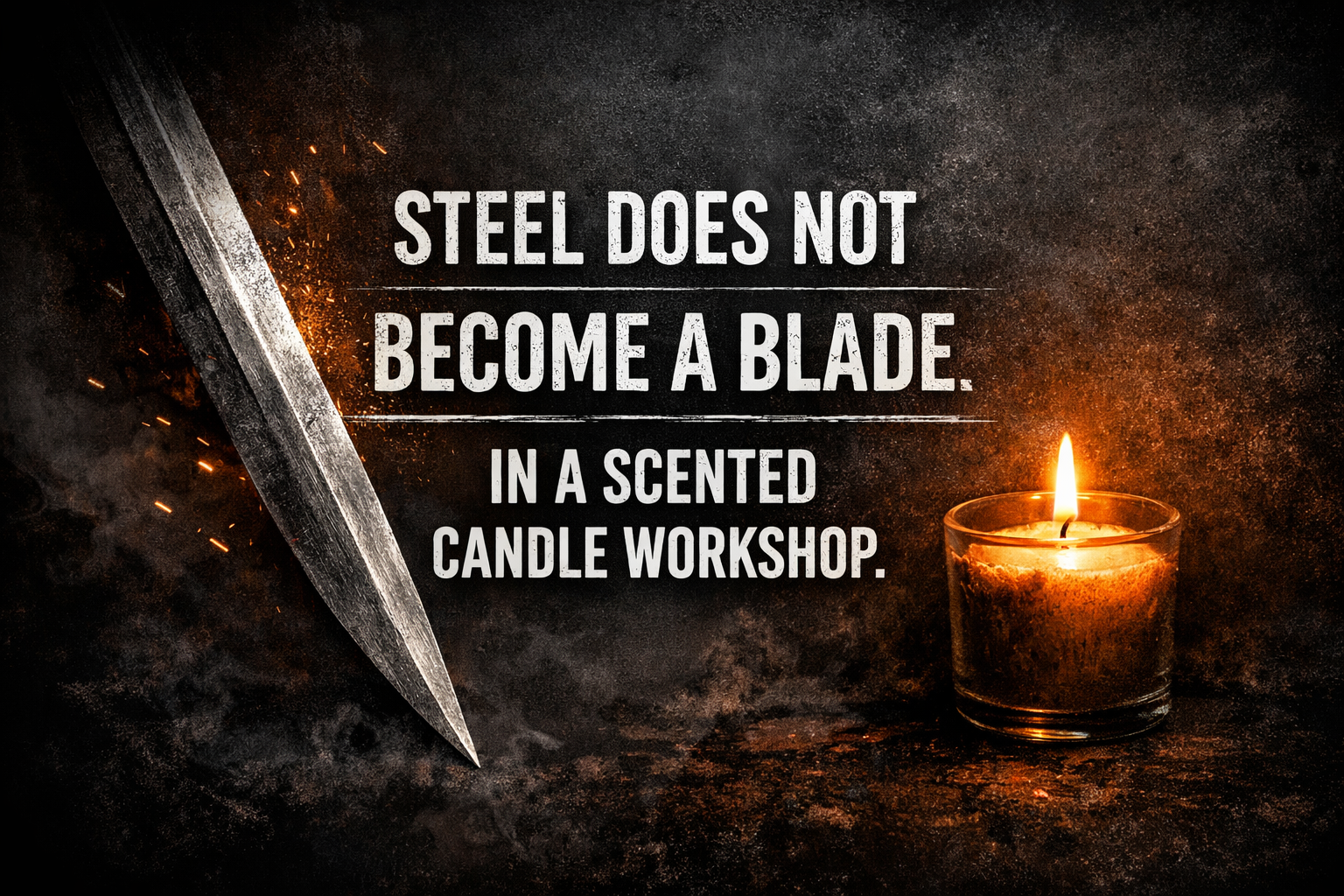
Steel does not become a blade in a scented candle workshop.
Why We Worship It
Let’s be honest.
Comfort feels good.
And in a world that feels uncertain, chaotic, and loud, comfort is controllable.
It’s immediate.
You cannot control geopolitics.
You cannot control markets.
You cannot control the future.
But you can control your sofa.
So you retreat.
And slowly, without noticing, your world shrinks to the size of your convenience.
You stop doing the thing that scares you.
You stop saying the thing that risks rejection.
You stop attempting the thing that might fail.
And then one day you look around and wonder why your life feels… smaller.
It isn’t because you lacked talent.
It’s because you bowed.
The Heresy of Discipline
Discipline is not the opposite of comfort.
It is the refusal to worship it.
Discipline says:
“I will act regardless of mood.”
It doesn’t consult emotion like an oracle.
It builds systems.
It shows up when motivation calls in sick.
It understands something comfort does not:
Temporary discomfort is the price of long-term freedom.
Freedom is not the ability to feel good all the time.
It is the ability to choose what is hard on purpose.
That is heresy in the modern age.
To voluntarily endure cold water.
To wake early.
To train when tired.
To speak when it trembles your voice.
But heresy is how revolutions begin.
Living Outside the Temple
Comfort is not the enemy.
Living your entire life inside its temple is.
Use comfort.
Rest. Recover. Enjoy warmth. Enjoy beauty.
But do not kneel to it.
If you never test yourself, you never meet yourself.
If you never resist impulse, you never build authority over your own mind.
If you never endure friction, you never develop strength.
And without strength, freedom is an illusion.
A Simple Question
Where in your life have you mistaken ease for wisdom?
Where have you called avoidance “alignment”?
Where have you baptised procrastination as “timing”?
You do not need to burn down your life.
You need to choose one deliberate discomfort.
One blade.
One thing you do daily regardless of mood.
Because when you practice discomfort voluntarily,
life loses its power to intimidate you involuntarily.
Comfort is a fine servant.
It is a terrible god.
And like all false gods, it asks for your potential in exchange for peace.
The trade looks small at first.
Until you realise what you’ve paid.
Now tell me.
Are you comfortable?
Or are you free?
Rebel Philosopher
www.rebelphilosopher.co.uk

Pending Reports...
Friction Isn’t a Sign to Stop. It’s the Door Handle.
Due Date June
Friction: Resistance shows up, you interpret it as danger.
Cause: Your nervous system confuses growth with threat.
Cut: Name the sensation (“tight chest”, “buzzing”, “dread”) and proceed anyway—slowly.
Proof: 5 “did it while uneasy” wins recorded.
The Two-Minute Betrayal
Due Date June 2026
Friction: You lose the day in tiny detours.
Cause: Micro-avoidance compounds into macro-failure.
Cut: Before any “quick check”, do one action toward the main task.
Proof: 10 consecutive “first move” wins.
Busy Is Not Productive (It’s Often Just Polite Panic)
Due Date June 2026
Friction: Your calendar looks full; your life looks unchanged.
Cause: Activity soothes anxiety without producing outcomes.
Cut: Choose one measurable weekly outcome and block the work first.
Proof: Outcome completed before Friday each week.
The Identity Trap: ‘That’s Not Me’
Due Date July 2026
Friction: You avoid actions that threaten your self-image.
Cause: The ego protects the story more than the future.
Cut: Act as the person you want to be for 5 minutes. Identity follows behaviour, not speeches.
Proof: A growing list of “I did the thing” evidence.
The Proof-of-Work Life
Due Date July
Friction: You want confidence without receipts.
Cause: You confuse thinking-about-it with building-it.
Cut: Build a “Proof Folder”: screenshots, logs, drafts, reps, shipped links.
Proof: 30 artifacts in 30 days.