
The Friction Report - BLOG
The Friction Report is a running dispatch from the front line of human avoidance.
No motivation sermons. No soft-focus coping.
Just clear thinking, practical cuts, and the small daily moves that make self-deception unemployed.
Click below to Access the Reports
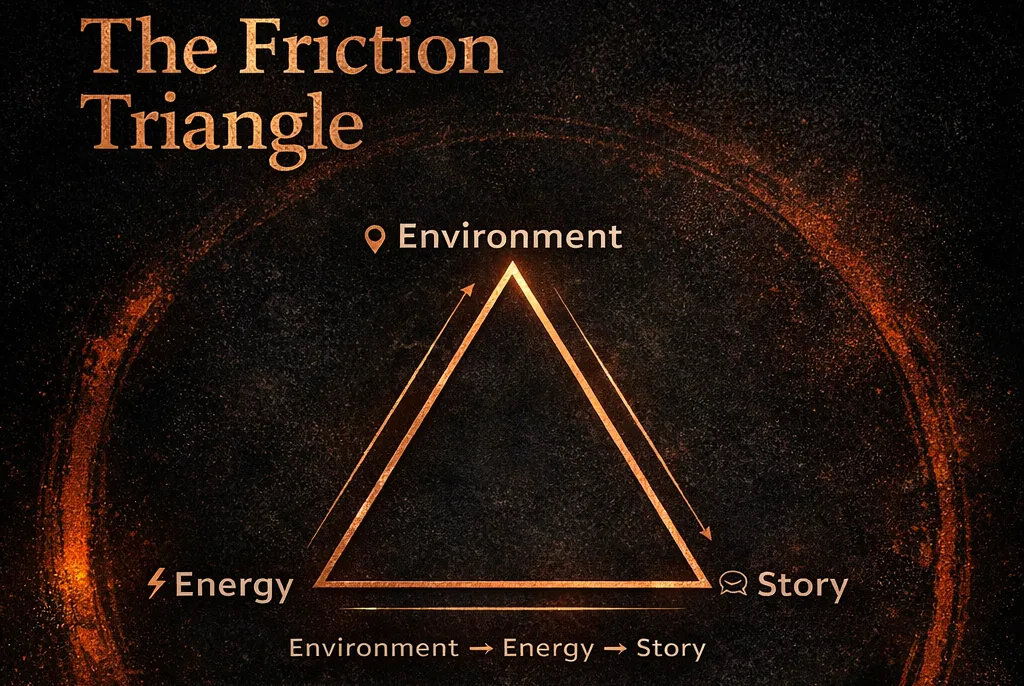
The Friction Triangle | Why Discipline Fails (And How to Fix It)
You don’t fail because you lack discipline.
You fail because you misunderstand where discipline comes from.
Most people think discipline is internal.
A trait. A quality. A personal strength you either have or you don’t.
So they try to fix it the only way they know how:
Push harder.
Try again.
Be better.
And for a while, it works.
Until it doesn’t.
The Problem With Willpower
Willpower is real.
But it’s unreliable.
It fluctuates with sleep, stress, mood, environment, and attention. It rises when things are easy. It disappears when things become difficult.
So when you rely on willpower to drive consistent behaviour, you’re building on something unstable.
That’s why discipline feels inconsistent.
Not because you are inconsistent.
Because your foundation is.
Behaviour Is Not Random
Here’s the shift.
Your behaviour is not a mystery.
It follows structure.
Every action you take — or avoid — is shaped by three forces working together:
Environment. Energy. Story.
This is the Friction Triangle.
And if you understand how these three interact, you stop guessing.
You start engineering.
The Triangle
Picture it simply:
At one point: Environment
At another: Energy
At another: Story
Your behaviour sits in the middle.
If all three support action, movement feels natural.
If even one resists, friction increases.
If all three resist, action collapses.
1. Environment — What Surrounds You
Environment is the most underestimated force.
It is everything external:
your physical space
your digital environment
what is visible, available, accessible
what requires effort vs what doesn’t
Environment answers a simple question:
What is easy to do right now?
If distraction is easy, you will drift.
If effort requires activation, you will delay.
Not because you lack discipline.
Because you are responding to structure.
The Invisible Influence
You don’t notice your environment most of the time.
That’s why it’s powerful.
If your phone is within reach, you will use it.
If food is visible, you will eat it.
If the task requires setup, you will postpone it.
You don’t debate these things.
You follow the path of least resistance.
The Key Insight
Environment doesn’t demand behaviour.
It suggests it.
Constantly.
2. Energy — What You Have Available
Energy is your internal state.
Not motivation.
Capacity.
physical energy
mental focus
emotional bandwidth
Energy answers:
Can I do this right now?
Even if the environment is perfect, low energy creates friction.
You sit down to work.
But you’re tired.
You hesitate.
You delay.
You soften.
Again — not laziness.
Capacity.
The Misunderstanding
People expect themselves to perform consistently regardless of energy.
That expectation is unrealistic.
You are not a machine.
You are a system.
And systems require fuel.
The Hidden Drain
Modern life quietly reduces energy:
constant stimulation
poor sleep
fragmented attention
emotional overload
So even when you want to act, you don’t feel able to.
And when that happens repeatedly, confidence drops.
3. Story — What You Tell Yourself
Story is the most subtle force.
It’s the narrative running in the background:
“I’m not disciplined”
“I work better later”
“I need to feel ready”
“I’ve done enough today”
Story answers:
Should I do this?
You can have the right environment.
You can have the energy.
But if your internal story resists, you will hesitate.
The Power of Narrative
Stories justify behaviour.
They make avoidance feel reasonable.
They turn delay into logic.
“I’ll start tomorrow.”
“I just need a break.”
“This isn’t the right time.”
Each one feels rational.
But repeated, they shape identity.
When the Triangle Collapses
Now bring it together.
You try to work.
But:
Your environment is full of distractions.
Your energy is low.
Your story says, “not today.”
What happens?
Nothing.
Not because you chose nothing.
Because the system didn’t support action.
Why Discipline Feels So Hard
Discipline feels hard when:
the environment pulls you away
the energy isn’t there
the story resists
You are trying to push forward while three forces pull back.
That is friction.
And friction always wins over time.
The Shift: From Effort to Design
Most people try to increase effort.
But effort is the weakest lever.
The stronger move is to change the triangle.
Adjust the Environment
remove easy distractions
reduce setup for important work
make the right action visible
Make effort easier.
Make distraction harder.
Protect the Energy
prioritise sleep
reduce unnecessary inputs
focus on fewer things
Stop expecting high performance from low capacity.
Rewrite the Story
replace “I can’t” with “I haven’t yet”
remove negotiation language
use identity deliberately
Not:
“I’ll try.”
But:
“I do this.”
Small Changes, Large Effects
You don’t need to fix everything.
You need to shift one point of the triangle.
Change one, and the system starts to move.
Change two, and momentum builds.
Change all three, and behaviour becomes natural.
The Realisation
You were never relying on discipline.
You were relying on alignment.
And when alignment is off, discipline feels like struggle.
When alignment is right, discipline feels like flow.
What Comes Next
Understanding the triangle gives you control.
But awareness is not enough.
You need a way to apply it.
To see where your triangle is misaligned.
To measure it.
To act on it.
→ Take: The Comfort Audit
→ Apply: The Anti-Comfort Protocol
→ Revisit: The Comfort Loop
You don’t need more motivation.
You need better structure.
Because behaviour is not something you force.
It is something you build.
www.rebelphilosopher.co.uk/blog/b/comfort-as-religion
www.rebelphilosopher.co.uk/blog/b/why-comfort-feels-right
www.rebelphilosopher.co.uk/blog/b/the-lie-of-you-deserve-this
www.rebelphilosopher.co.uk/comfort-loop

Pending Reports...
Friction Isn’t a Sign to Stop. It’s the Door Handle.
Due Date June
Friction: Resistance shows up, you interpret it as danger.
Cause: Your nervous system confuses growth with threat.
Cut: Name the sensation (“tight chest”, “buzzing”, “dread”) and proceed anyway—slowly.
Proof: 5 “did it while uneasy” wins recorded.
The Two-Minute Betrayal
Due Date June 2026
Friction: You lose the day in tiny detours.
Cause: Micro-avoidance compounds into macro-failure.
Cut: Before any “quick check”, do one action toward the main task.
Proof: 10 consecutive “first move” wins.
Busy Is Not Productive (It’s Often Just Polite Panic)
Due Date June 2026
Friction: Your calendar looks full; your life looks unchanged.
Cause: Activity soothes anxiety without producing outcomes.
Cut: Choose one measurable weekly outcome and block the work first.
Proof: Outcome completed before Friday each week.
The Identity Trap: ‘That’s Not Me’
Due Date July 2026
Friction: You avoid actions that threaten your self-image.
Cause: The ego protects the story more than the future.
Cut: Act as the person you want to be for 5 minutes. Identity follows behaviour, not speeches.
Proof: A growing list of “I did the thing” evidence.
The Proof-of-Work Life
Due Date July
Friction: You want confidence without receipts.
Cause: You confuse thinking-about-it with building-it.
Cut: Build a “Proof Folder”: screenshots, logs, drafts, reps, shipped links.
Proof: 30 artifacts in 30 days.