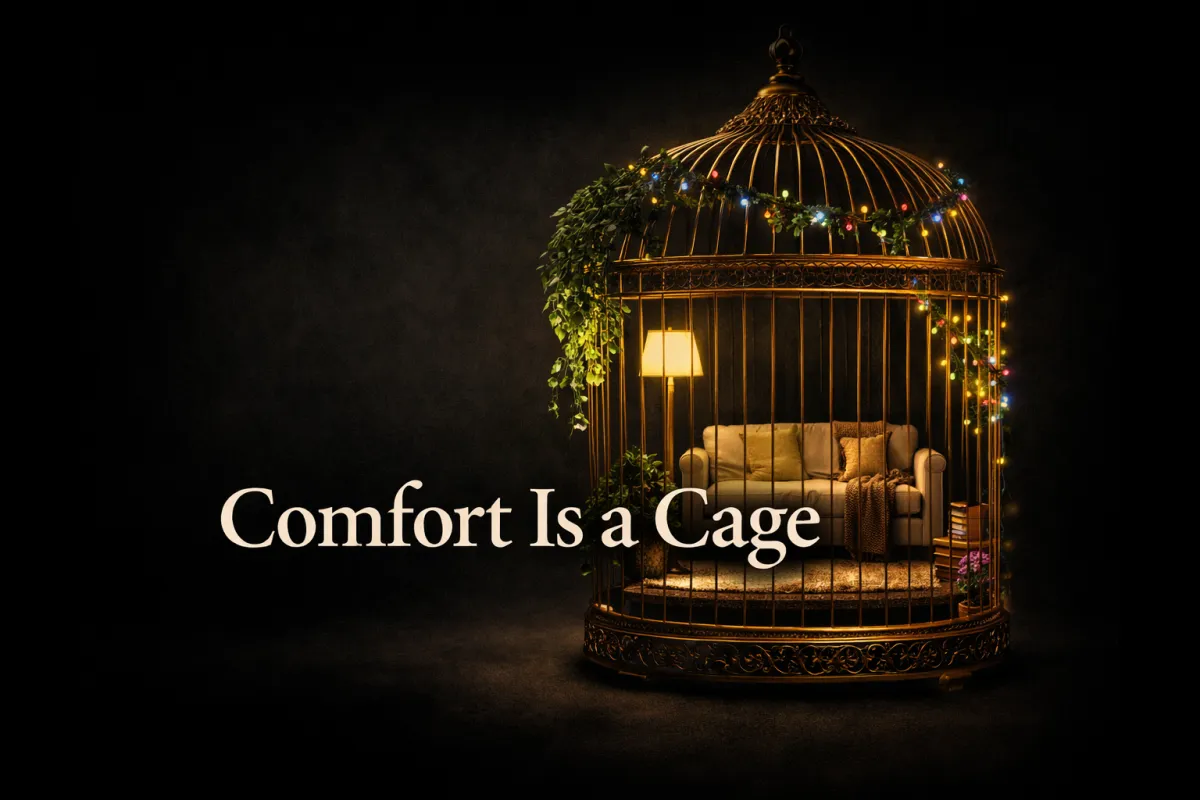
Comfort Is A Cage
Some cages are easy to recognise. They have locks, rules and visible limits.
The most effective cages do not look like cages at all. They look sensible. Familiar. Comfortable. They come with a favourite chair, a predictable routine and enough small pleasures to stop you asking whether your life is becoming smaller.
This is how comfort becomes confinement. Not because rest is wrong, but because relief quietly replaces movement.
The cage is not comfort itself. The cage is the life you keep arranging so that nothing can disturb you.
The cage you keep decorating
People rarely decide to abandon their ambitions in one dramatic moment. They decorate the retreat instead.
They improve the routine that keeps them safe. They buy tools for work they never begin. They organise plans that never meet resistance. They call avoidance balance and call delay preparation.
Each decision appears harmless. Together they create a life that is increasingly pleasant to inhabit and increasingly difficult to leave.
The decoration matters because it hides the loss. A visibly miserable situation creates pressure to change. A tolerable one can survive for years. It gives you enough comfort to remain and enough frustration to feel permanently disappointed with yourself.
You may still speak about the book, business, conversation, move or decision. You may sincerely intend to act. But intention becomes part of the decoration when it is never converted into movement.
How a comfortable cage is built
The structure usually develops through four quiet choices.
1. Predictability replaces possibility
You begin choosing what you can control over what might enlarge you. The familiar route wins because it cannot embarrass you, reject you or reveal that you are still learning.
Nothing is obviously wrong with the predictable choice. The cost appears later, when you realise that your days have become highly manageable and strangely lifeless.
2. Relief becomes the decision-maker
When tension appears, you reach for the action that removes it fastest. You scroll, snack, tidy, research, overwork or postpone. The specific behaviour matters less than its function.
Relief teaches the nervous system that discomfort is a threat and escape is the answer. Each repetition makes the next escape feel more reasonable.
3. Your explanations become more sophisticated
At first you say, “I do not feel like it.” Later the explanation becomes more respectable.
You need more clarity. The timing is poor. You are protecting your energy. The market is uncertain. Other people need you. The plan deserves more thought.
Some of these claims may contain truth. The question is whether they clarify action or protect you from it.
4. The cage becomes part of your identity
Eventually the pattern stops feeling like a choice. It becomes a description of who you are.
You are cautious. You are not good at confrontation. You work better under pressure. You are waiting for confidence. You are simply someone who needs more time.
An identity can make a repeated behaviour feel permanent. Once the cage is described as personality, leaving it begins to feel like betrayal rather than growth.
Comfort, rest and avoidance are not the same
A useful life needs rest. Recovery protects judgement, creativity and health. The aim is not permanent strain or performative toughness.
Rest returns you to life with more capacity. Avoidance removes you from life without resolving what made you leave.
After real rest, the difficult action becomes more possible. After avoidance, it usually feels heavier. You have the original task plus the residue of delay.
Ask a simple question after any comfort behaviour: “Do I now have more capacity to meet what matters, or have I made it easier to continue hiding?”
The answer separates restoration from retreat.
The price is paid in self-trust
The obvious cost of a comfortable cage is lost opportunity. The deeper cost is the weakening of your relationship with your own word.
Each time you make an agreement and quietly reopen it when discomfort arrives, you collect evidence. Not evidence that you are incapable, but evidence that your decisions have no authority when they become inconvenient.
This is why another inspiring plan rarely fixes the problem. The plan may be excellent. The person reading it has learned not to believe their own promises.
Self-trust returns through smaller evidence. One message sent. Ten minutes completed. One boundary held. One truthful conversation begun.
The scale of the action is less important than the fact that it crosses the threshold between intention and behaviour.
A five-part cage audit
Choose one area where you feel contained. Do not audit your whole life at once. Use these five questions.
What am I protecting myself from? Name the discomfort precisely. Rejection, uncertainty, embarrassment, grief, effort and responsibility require different responses.
What do I do to create relief? Identify the behaviour without moral drama. The purpose is accuracy, not self-attack.
What story makes the relief sound wise? Write the sentence you use to justify delay. This exposes the argument that keeps the door closed.
What is the accumulating cost? Count what the pattern is taking from your work, relationships, health, courage or self-respect.
What is the smallest exit movement? Choose an action that changes your position today, even if it does not solve the whole problem.
A cage audit is useful only if it ends in movement. Insight without action can become another expensive decoration.
Do not demolish your life
When people finally recognise confinement, they sometimes reach for a dramatic escape. They quit, confront, announce or redesign everything at once.
Sometimes decisive change is necessary. Often the urge for drama is another attempt to avoid the slower work of becoming reliable.
You do not need to destroy every comfort. You need to remove its authority over one meaningful decision.
Open the document before you evaluate your mood. Make the call before you create a better script. Walk for ten minutes before you design the perfect programme. State the boundary before you explain it for the fifth time.
The first exit is rarely cinematic. It is a small act completed without asking comfort for permission.
The Threshold Protocol
Use this when you notice yourself decorating instead of leaving.
Name the cage. State the pattern plainly: “I am using research to avoid exposure.”
Name the door. Identify the action that would change your position.
Reduce the crossing. Make the first movement small enough to begin within five minutes.
Let discomfort travel with you. Do not wait for the feeling to disappear. Carry it into the action.
Record the exit. Write one sentence describing what you did. This becomes evidence that the cage is a pattern, not an identity.
Repeat the protocol in the same arena for seven days. Consistency turns a temporary exit into a new route.
What freedom actually feels like
Freedom is often described as ease, but meaningful freedom includes friction. It asks you to tolerate uncertainty, incomplete control and the possibility of being changed by what you begin.
The reward is not a life without discomfort. It is a life in which discomfort no longer makes every important decision.
Your familiar routines may continue calling you back. The chair will still be comfortable. The explanation will still sound intelligent. The difference is that you can now see the structure.
Comfort can be a place you visit. It should not become the address where your unlived life is stored.
Make one exit today
Choose the area you already know you have been decorating.
Write the story that keeps you inside. Name the cost. Then complete one action that changes your position before the day ends.
Do not wait for certainty. Certainty is often one of the furnishings.
Use the free Comfort Audit to identify the relief pattern directing your choices. Read The Comfort Loop when you need to diagnose the trigger, story, numbing behaviour and cost. Continue with Stop Negotiating With Yourself when the door is visible but internal bargaining keeps you inside.
Continue the work
Use these next steps to turn recognition into movement.
Run the Comfort Audit
Identify the relief pattern directing your choices.Understand the Comfort Loop
Diagnose the trigger, story, numbing behaviour and accumulating cost.Stop Negotiating With Yourself
End the internal bargaining when the door is already visible.