
The Comfort Loop | Why You Keep Delaying What Matters
There is a moment you recognise.
You sit down for a minute.
You open your phone.
You tell yourself you’ll start shortly.
And then… you don’t.
Not because you decided not to.
Because something took over.
It Doesn’t Feel Like a Pattern
It feels like a choice.
“I just need a break.”
“I’ll start in a bit.”
“Let me reset first.”
Nothing dramatic.
Nothing irrational.
But if you zoom out, something becomes clear.
You don’t do it once.
You do it often.
And often enough becomes identity.
The Loop
The Comfort Loop is simple.
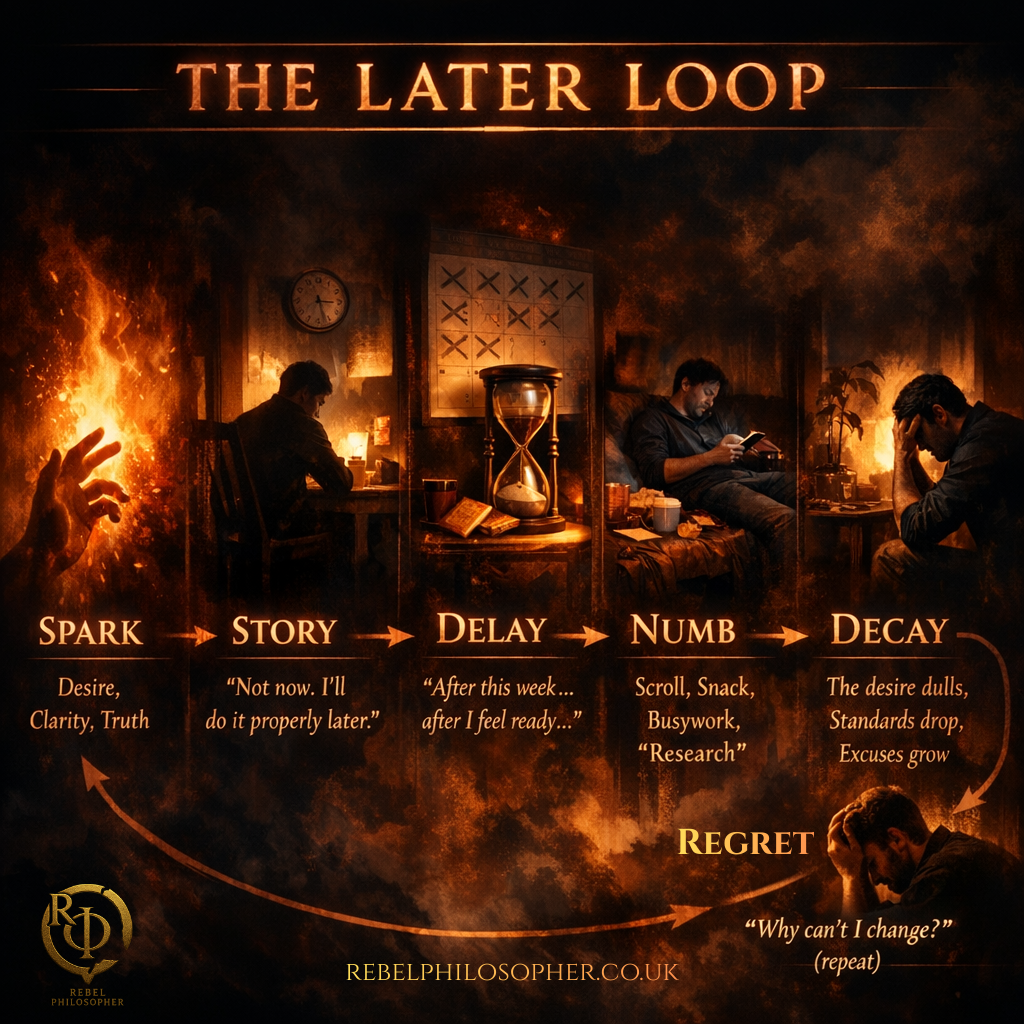
Trigger → Relief → Delay → Diminished Action → Guilt → Repeat
It runs quietly, beneath awareness.
Something feels difficult.
You move toward ease.
You delay the thing that matters.
You do less than you intended.
You feel it.
And then you reset — not by acting, but by escaping again.
Why It Works So Well
Because it solves the immediate problem.
Discomfort.
The moment you shift toward something easy — scrolling, watching, eating, avoiding — the tension drops.
The nervous system relaxes.
The signal is clear:
That worked.
Your brain learns quickly.
Not what is good for you.
What removes discomfort fastest.
The Invisible Training
Each time the loop runs, it teaches you something:
Avoidance works.
Not in theory.
In practice.
Because it gives you immediate relief.
The cost comes later.
But later is abstract.
Now is real.
Why “Later” Keeps Repeating
You don’t avoid things permanently.
You postpone them.
“I’ll do it later.”
That’s what makes the loop sustainable.
It preserves your self-image.
You’re still the kind of person who will do it.
Just not now.
But “later” isn’t a time.
It’s a pattern.
And patterns repeat.
The Shrinking Effect
The most dangerous part of the Comfort Loop isn’t delay.
It’s contraction.
Over time:
You take on less.
You attempt less.
You push less.
Not because you chose to shrink.
Because you trained yourself to avoid expansion.
Your world becomes more manageable.
But also smaller.
Why It Doesn’t Look Like Failure
Because it’s subtle.
You still function.
You still work.
You still move forward — slowly.
Nothing collapses.
But nothing accelerates either.
You hover.
Between intention and action.
The Emotional Signature
The Comfort Loop doesn’t feel like laziness.
It feels like:
low-level resistance
quiet frustration
background guilt
unfinished energy
You know you’re capable of more.
But you rarely access it.
The Break Point
The loop only breaks when you interrupt the sequence.
Not with motivation.
With action.
Specifically:
Acting before relief.
Doing the thing before you soften the edge.
Before you scroll.
Before you sit.
Before you “just take a minute.”
Because once relief comes first, action weakens.
The Uncomfortable Truth
You don’t need more motivation.
You need fewer escape routes.
Because as long as relief is always available, effort will always be optional.
And when effort is optional, it rarely happens at full depth.
What Comes Next
Understanding the loop is one thing.
But it doesn’t operate in isolation.
It is supported by something deeper.
A structure.
Three forces working together.
Environment.
Energy.
Story.
→ Explore: The Friction Triangle
→ Read: Why Comfort Feels Right
→ Try: The Anti-Comfort Protocol
You don’t rise to your intentions.
You repeat your patterns.
And until you see the loop clearly…
you will continue to live inside it.
https://www.rebelphilosopher.co.uk/blog/b/comfort-as-religion
www.rebelphilosopher.co.uk/blog/b/why-comfort-feels-right
https://www.rebelphilosopher.co.uk/blog/b/the-lie-of-you-deserve-this
