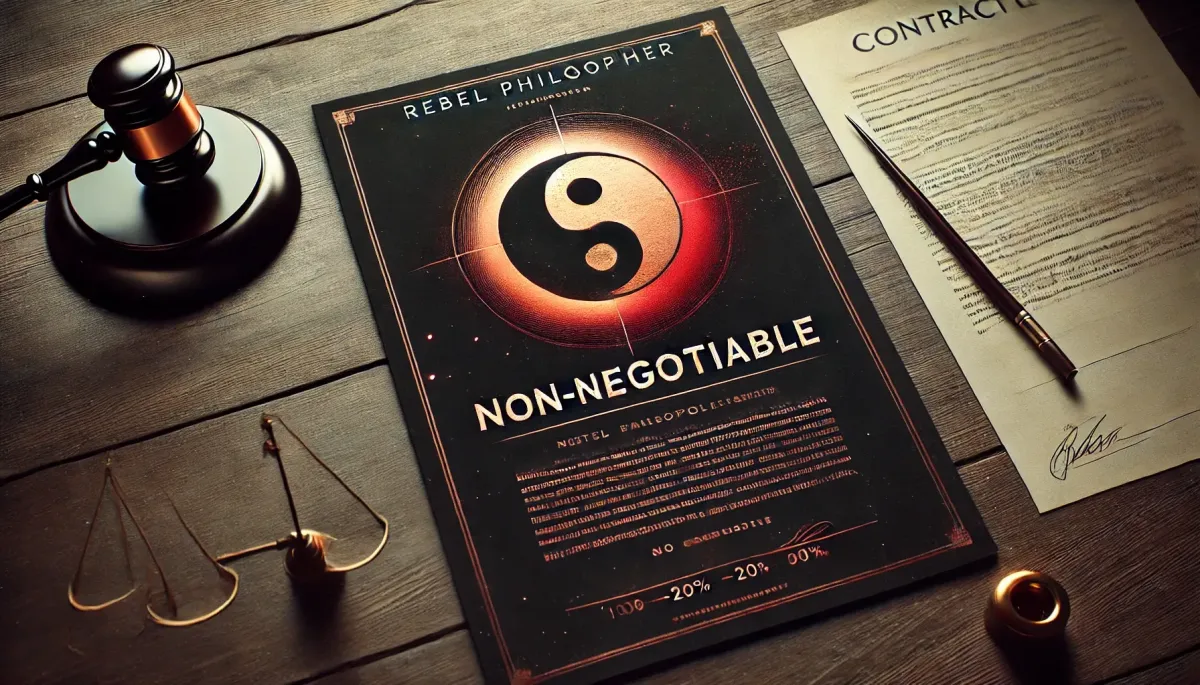
Stop Negotiating With Yourself
Stop Negotiating With Yourself.
Your life is being run by a committee
Inside your head, there is a meeting. It is always in session. Everyone is talking at once. No one is taking minutes. And somehow the laziest person in the room keeps getting the final vote.
That’s “negotiating with yourself.”
It sounds mature—reasonable, balanced, open-minded—until you notice the results:
You keep postponing the same thing.
You keep “starting fresh” on Monday like Monday is a magical priest.
You keep making deals with comfort and calling it strategy.
Negotiation is useful for diplomacy. It’s terrible for habits.
Because the part of you you’re negotiating with is not a rational adult. It’s a comfort-seeking animal with excellent language skills.
What negotiation really is
Negotiation is the moment your brain says:
“Let’s discuss whether we really need to do this.”
And the minute you allow a debate, you’ve already lost. Not because you’re weak—because debate is a stalling mechanism. Debate is delay dressed up as intelligence.
You don’t need more discussion. You need a rule.
Rules remove the daily referendum.
The No-Debate Principle
Self-trust is built when your behaviour becomes predictable to your own nervous system.
Predictable means:
Less talking.
More structure.
Clear triggers.
Smaller actions.
Automatic start.
The moment you start arguing with yourself, the “old you” is back in control—because the old you knows every loophole in your psychology. It wrote them.
So the goal isn’t motivation. It’s no courtroom.
No trial. No defense. No emotional cross-examination.
Just: start.
The 3 Negotiation Traps (and how to cut them)
1) “I’ll do it later, properly.”
Translation: “I want the comfort now and the pride later.”
Cut it with: Minimum viable action.
If “properly” isn’t possible today, do the smallest version that keeps the chain alive.
2) “I don’t have time.”
Sometimes true. Often it means: “I don’t want the discomfort.”
Cut it with: Time-boxing.
10 minutes. Start the timer. Your brain can’t argue with an appointment that short without revealing it’s lying.
3) “I’m not in the right headspace.”
That’s a charming sentence. It’s also usually avoidance.
Cut it with: Start ritual.
One tiny action that begins the behaviour regardless of mood:
Open the doc.
Put on shoes.
Lay out the mat.
Write the first ugly line.
Headspace follows motion.
The Stop Negotiating Protocol (SN-1)
Here’s the drill. Use it for one arena for 7 days.
Step 1 — Write a rule that fits on one line.
Examples:
“At 7:30pm, I do 10 minutes of writing.”
“After coffee, I walk for 10 minutes.”
“Before scrolling, I do one rep of the task.”
If the rule is complicated, it’s an invitation to renegotiate.
Step 2 — Decide the “minimum” and the “bonus.”
Minimum = always. Bonus = optional.
Minimum: 10 minutes.
Bonus: keep going if you want.
This is how you avoid all-or-nothing insanity.
Step 3 — Remove the vote.
Write this sentence somewhere visible:
“This is not a decision. It’s a procedure.”
Your brain loves decisions because decisions can be delayed.
Step 4 — Start ritual (30 seconds).
Pick a start cue that’s embarrassingly simple.
“Open the file.”
“Put shoes on.”
“Set timer.”
Step 5 — Log the receipt.
If you don’t log it, your brain will forget it and then demand “confidence” again.
What to do when you do negotiate
You will. That’s normal. The mind is a lawyer—it can argue that fire is cold if it thinks it gets a biscuit.
When you catch yourself negotiating, don’t wrestle. Don’t shame yourself. Don’t start a TED Talk about discipline.
Just say:
“Noted. Starting the timer.”
Then start the timer.
The point isn’t to become a monk. It’s to become unbribable by comfort.
The strange peace of rules
Here’s the paradox: rules feel restrictive, but they create freedom.
Negotiation keeps you trapped because it forces you to re-decide every day. That’s exhausting. It burns attention like petrol.
A rule is restful. A rule is like gravity: you don’t argue with it; you move with it.
And after a week, something changes:
The meeting in your head gets quieter.
Because the committee realizes it no longer has jurisdiction.
Practice: Write your “No Negotiation Contract”
Copy/paste and fill:
Arena (one): ______________________
Rule (one line): ____________________
Minimum (10 min or less): __________
Start ritual (30 seconds): __________
Receipt log method: ________________
Then add one final sentence:
“If I start negotiating, I start the timer.”
That’s it. That’s the whole spell.
Closing: stop bargaining with your own life
Negotiation has its place. But if you negotiate with yourself about the thing that would change your life, you are basically holding your future hostage and demanding a ransom in comfort snacks.
Stop the meeting.
Write a rule.
Start small.
Log the receipt.
And watch how quickly self-trust returns when you stop debating with the part of you that’s addicted to staying the same.
Run SN-1 for 7 days inside Breaking Free. One arena. One rule. No debate. Receipts only.
