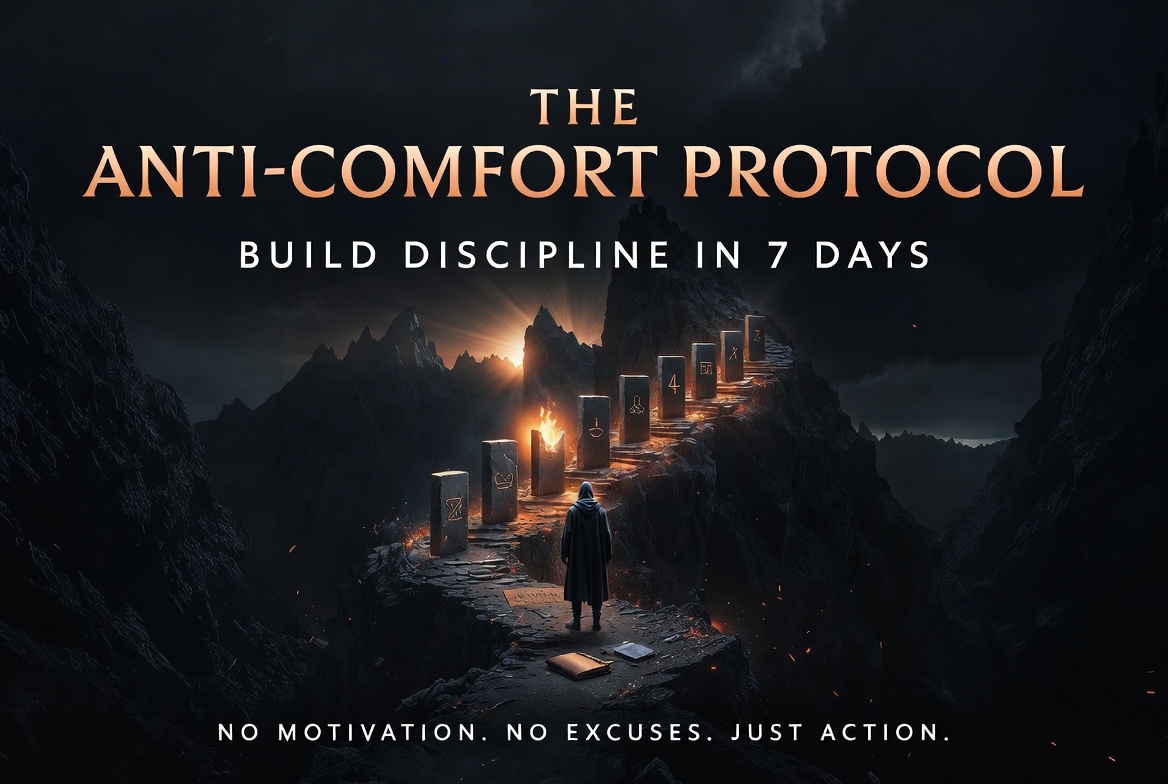
The Anti-Comfort Protocol | Build Discipline in 7 Days
Most people don’t change because they don’t try.
They change for a day.
Maybe two.
They feel the friction. They push through it briefly. They prove to themselves that they can act differently.
And then they stop.
Not because they failed.
Because they drifted.
Why Insight Doesn’t Create Change
By now, you understand the system.
You see how comfort operates.
You recognise the loop.
You can identify the structure.
But understanding does not create transformation.
It creates potential.
The gap between knowing and doing is not filled by intention.
It is filled by repetition.
The Problem With “Trying Harder”
Most attempts at change rely on intensity.
You decide to improve.
So you go all in.
You wake up earlier.
You train harder.
You remove distractions.
You push.
For a while, it works.
Then something happens.
Your energy drops.
Your environment pulls you back.
Your story shifts.
And the system reasserts itself.
You interpret this as failure.
But it isn’t.
It’s inconsistency.
The Principle
Lasting change does not come from intensity.
It comes from structured exposure to discomfort.
Repeated.
Measured.
Deliberate.
That is the Anti-Comfort Protocol.
What This Is (And What It Isn’t)
This is not punishment.
It is not about making life unnecessarily hard.
It is not about rejecting comfort entirely.
This is about:
Reintroducing friction in a controlled way.
Because friction builds capacity.
And capacity creates freedom.
The Objective
The goal is simple:
Increase your tolerance for discomfort.
Not through extremes.
Through consistency.
The Structure
The protocol runs over 7 days.
Not because 7 days changes your life.
But because 7 days proves something important:
You can act independently of how you feel.
The Rules
There are only three.
1. One Blade
Choose one area.
Not five. Not three.
One.
It might be:
starting work at a fixed time
training daily
removing your phone during work
finishing what you start
Keep it narrow.
Precision creates consistency.
2. No Negotiation
Once chosen, the action is fixed.
No adjustment based on mood.
No delay.
No “later.”
You act at the defined time.
Or you don’t.
There is no middle ground.
3. Daily Execution
You repeat the action every day.
Not perfectly.
But deliberately.
Even when it feels unnecessary.
Even when it feels inconvenient.
Especially when it feels difficult.
Why This Works
Because it changes the relationship between:
feeling → action
Most people act when they feel ready.
This protocol reverses it.
You act.
Then you feel.
The First Resistance
The first few days feel unnatural.
You will notice:
hesitation
internal negotiation
subtle resistance
This is not a sign to stop.
It is a sign you are in the right place.
The Middle Phase
Around day three or four, something shifts.
The action becomes familiar.
Not easy.
But less dramatic.
You begin to expect it.
The resistance doesn’t disappear.
But it weakens.
The Final Days
By day six or seven, something becomes clear.
You are no longer reacting.
You are directing.
Not in everything.
But in this one area.
And that matters.
What You’re Actually Building
This is not about the task.
It is about:
self-trust.
When you do what you said you would do — repeatedly — something stabilises.
You begin to believe yourself.
And without that, nothing else holds.
The Expansion
After seven days, you have a choice.
You can:
continue the same action
expand slightly
introduce a second blade
But you do not abandon structure.
That is how people regress.
The Common Mistake
Trying to do too much.
Too early.
You feel momentum.
So you add more.
And the system collapses.
Resist that.
Growth is not built through overload.
It is built through consistency.
The Deeper Shift
As the protocol continues, something else changes.
You stop seeing discomfort as a signal to avoid.
You start seeing it as:
a signal to engage.
That is a fundamental shift.
The Relationship With Comfort
You do not eliminate comfort.
You change its position.
Comfort becomes:
recovery
reward (used carefully)
support
Not default.
Not escape.
The Result
You become someone who:
acts without waiting
tolerates friction
follows structure
Not perfectly.
But consistently.
And consistency compounds.
What Comes Next
The protocol is not the end.
It is the beginning.
Because once you prove you can act in one area…
You can apply it to others.
→ Revisit: The Comfort Audit
→ Strengthen: Remove the Option
→ Deepen: The Friction Triangle
You don’t need a new system.
You need to use one.
Repeatedly.
Until it becomes part of how you operate.
Comfort will always be available.
The question is:
Will you always take it?
https://www.rebelphilosopher.co.uk/blog/b/comfort-as-religion
https://www.rebelphilosopher.co.uk/blog/b/why-comfort-feels-right
https://www.rebelphilosopher.co.uk/blog/b/comfort-loop
https://www.rebelphilosopher.co.uk/blog/b/you-are-not-lazy
https://www.rebelphilosopher.co.uk/blog/b/friction-triangle
