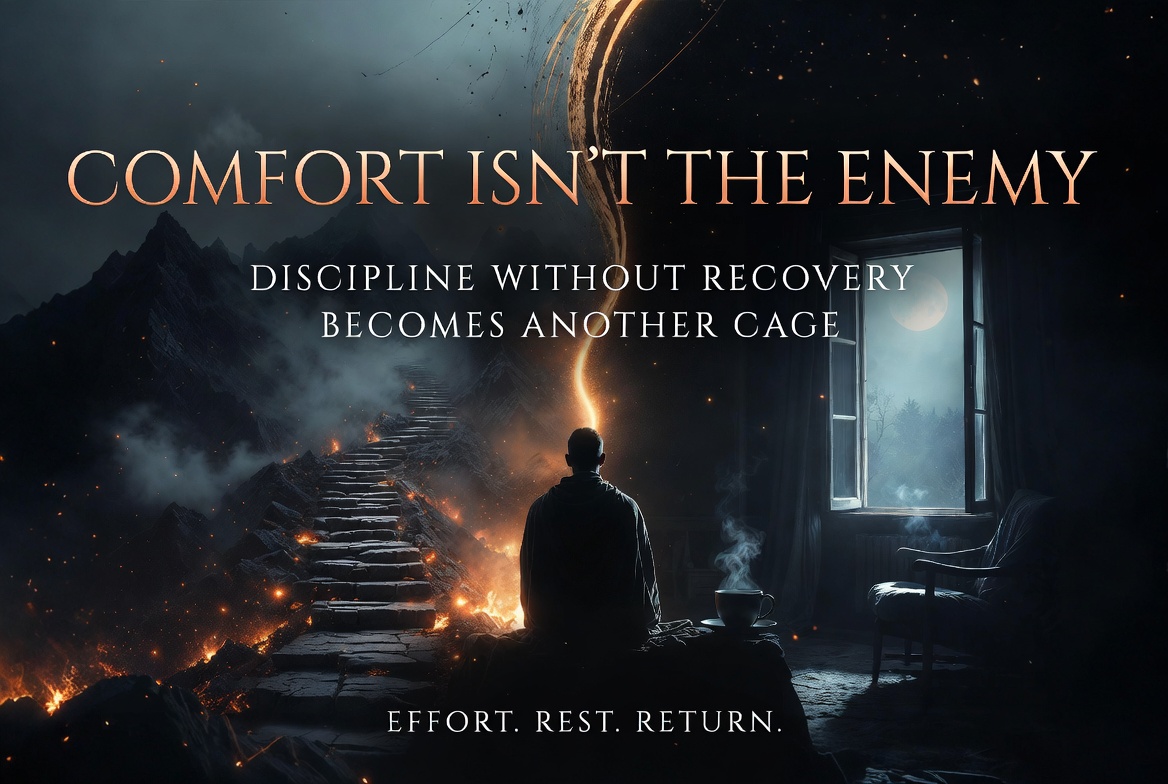
Comfort Isn’t the Enemy | The Balance Between Discipline and Ease
It would be easy to leave things where they are.
To draw a hard line.
Comfort is bad.
Discomfort is good.
Choose the harder path.
Simple. Clean. Convincing.
And incomplete.
The Temptation of Extremes
Once you see the cost of comfort, there’s a natural reaction.
You want to reject it.
You want to move in the opposite direction.
You want to become disciplined, structured, resistant.
And that instinct is understandable.
But it carries a risk.
Because when you swing too far, you don’t escape the system.
You recreate it.
The New Religion
It is possible to turn discomfort into a religion.
To measure your worth by how hard things feel.
To seek difficulty for its own sake.
To reject ease even when it is appropriate.
This looks like strength.
But often, it is just another form of attachment.
You are still being controlled.
Just by a different idea.
What Comfort Actually Is
Comfort is not the problem.
Comfort is a tool.
It is:
rest after effort
recovery after strain
warmth after exposure
space after intensity
Used correctly, comfort restores you.
It allows you to sustain effort over time.
It makes long-term growth possible.
Where It Goes Wrong
The issue is not comfort.
It is default comfort.
When comfort becomes:
the starting point
the fallback option
the constant state
Then it stops supporting you.
And starts shaping you.
The Difference Between Use and Dependence
There is a difference between:
Using comfort
and
Depending on comfort
Using comfort means:
You can enter it.
You can leave it.
You are not defined by it.
Dependence means:
You need it to function.
You avoid its absence.
You structure your life around maintaining it.
The Test
A simple question reveals the truth:
Can you operate without it?
Can you:
work without perfect conditions
act without feeling ready
move without motivation
tolerate discomfort without escape
If the answer is no, then comfort is no longer a tool.
It is a requirement.
The Role of Discomfort
Discomfort is not valuable because it is painful.
It is valuable because it expands capacity.
It teaches you:
to tolerate effort
to handle uncertainty
to act under pressure
to continue when it would be easier to stop
Discomfort is not the goal.
It is the mechanism.
The Balanced Position
The goal is not:
maximum discomfort
It is:
appropriate discomfort
Enough to grow.
Not so much that you collapse.
Enough to stretch.
Not so much that you break.
The Rhythm
A sustainable life has rhythm.
Effort → recovery
Tension → release
Discomfort → comfort
The problem arises when the rhythm disappears.
When it becomes:
comfort → comfort → comfort
Or:
strain → strain → strain
Both are unsustainable.
The Intelligent Use of Comfort
Comfort should be:
earned, not assumed
timed, not constant
supportive, not dominant
It should follow effort.
Not replace it.
The Subtle Shift
Instead of asking:
“How can I be more comfortable?”
Ask:
“What does this moment require?”
Sometimes the answer is rest.
Sometimes it is effort.
Sometimes it is restraint.
Sometimes it is action.
The Danger of Identity
Do not build your identity around:
being comfortable
or
being uncomfortable
Both are limiting.
Identity should be built around:
response
You respond to what is needed.
Not what is easy.
Not what is hard.
What is appropriate.
What This Changes
When you understand this, something stabilises.
You stop reacting to comfort.
You stop chasing discomfort.
You start making decisions.
Deliberate ones.
The Quiet Confidence
There is a different kind of confidence that emerges.
Not loud.
Not performative.
Just steady.
You know you can:
enter discomfort when required
use comfort when needed
move between the two without losing direction
That is control.
The Integration
Now everything comes together.
Comfort is not removed.
It is repositioned.
Discomfort is not avoided.
It is applied.
Structure is not rigid.
It is intentional.
What Comes Next
This is not the end of the process.
It is the beginning of a more precise one.
Where you stop thinking in extremes.
And start thinking in systems.
→ Revisit: The Friction Triangle
→ Apply: The Anti-Comfort Protocol
→ Reflect: The Comfort Audit
Comfort was never the enemy.
Worship was.
And once you remove worship…
you are free to use everything properly.
https://www.rebelphilosopher.co.uk/blog/b/comfort-as-religion
https://www.rebelphilosopher.co.uk/blog/b/why-comfort-feels-right
https://www.rebelphilosopher.co.uk/blog/b/comfort-loop
https://www.rebelphilosopher.co.uk/blog/b/friction-triangle
