
The Friction Report - BLOG
The Friction Report is a running dispatch from the front line of human avoidance.
No motivation sermons. No soft-focus coping.
Just clear thinking, practical cuts, and the small daily moves that make self-deception unemployed.
Click below to Access the Reports
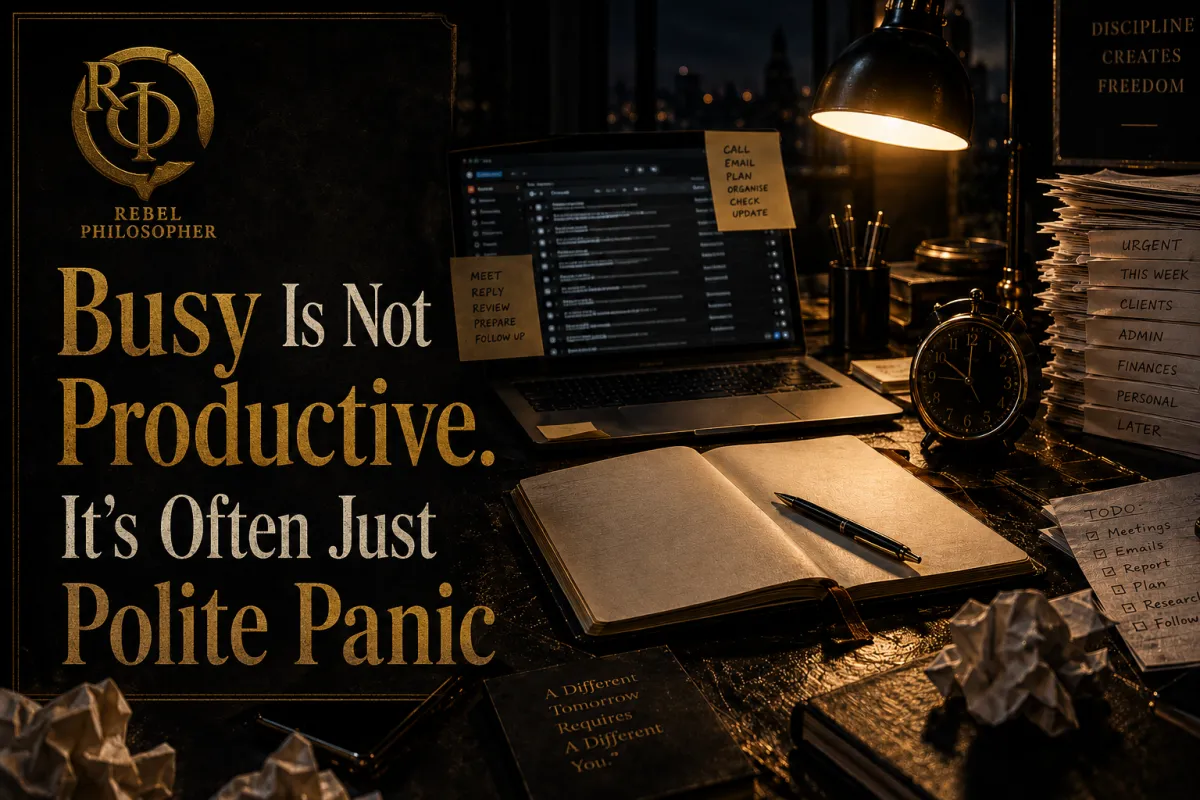
Busy Is Not Productive. It’s Often Just Polite Panic
There is a particular kind of person who is always busy.
Not lazy.
Not careless.
Not sitting around doing nothing.
Busy.
Inbox open.
Calendar full.
Tabs everywhere.
Notes half-written.
Messages answered.
Meetings attended.
Tasks shuffled.
Plans revised.
Lists rewritten.
From the outside, it looks like discipline.
From the inside, it often feels like drowning with good manners.
This is the trick.
Busyness can look responsible while quietly protecting you from the work that would actually change your life.
It gives you movement without contact.
Noise without decision.
Effort without exposure.
And because the culture applauds activity, you can spend years hiding inside motion and still be congratulated for your work ethic.
That is why busy is so dangerous.
It does not look like avoidance.
It looks like being needed.
Respectable Avoidance
Most people imagine avoidance as obvious.
Scrolling for hours.
Sleeping too much.
Drinking too much.
Procrastinating openly.
Letting everything fall apart.
And yes, sometimes avoidance looks like that.
But avoidance has a more respectable costume.
It can look like replying quickly.
It can look like staying late.
It can look like helping everyone else first.
It can look like researching more.
It can look like organising the plan instead of executing it.
It can look like being the reliable one.
The more competent you are, the more sophisticated your avoidance becomes.
You do not need to run away from your life dramatically.
You can simply bury the dangerous thing beneath a mountain of reasonable obligations.
You can say, “I just haven’t had time,” and everyone will nod, because time is the alibi no one wants to question.
But often the truth is not that you had no time.
The truth is that the real work required a version of you that could not hide behind usefulness.
Polite Panic
Busyness often begins as panic.
Not the cinematic kind.
Not shaking hands and dramatic breakdowns.
A quieter panic.
The panic of being still long enough to know what you are avoiding.
The panic of choosing one path and losing the fantasy of all the others.
The panic of sending the message.
The panic of publishing the thing.
The panic of admitting what you want.
The panic of no longer being able to pretend that preparation is the same as courage.
So you become busy.
You answer the easy email.
You tidy the desk.
You improve the spreadsheet.
You watch another tutorial.
You create a better system.
You offer to help someone else.
You find a smaller fire and rush towards it with heroic energy.
This feels noble.
But sometimes noble is just panic wearing a clean shirt.
That is polite panic.
It does not scream.
It schedules.
It does not collapse.
It over-functions.
It does not admit fear.
It says, “I’m just snowed under.”
The Productivity Mask
Productivity can become one of the most elegant hiding places in modern life.
There is nothing wrong with systems, planning, calendars, tools, workflows, dashboards, reminders, trackers, notebooks, or lists.
Used properly, they reduce friction.
Used dishonestly, they become theatre.
A new system can feel like progress because it gives you the emotional reward of action without the danger of output.
You can spend two hours building the perfect writing schedule and never write the sentence.
You can reorganise your business ideas and never make the offer.
You can refine your morning routine and never confront the decision waiting at noon.
You can consume advice about discipline while avoiding the one act of discipline that would make the advice unnecessary.
This is where productivity becomes costume.
You are not building a life.
You are managing the appearance of someone who might.
Busy Keeps You Innocent
One of the hidden benefits of staying busy is that it keeps you innocent.
As long as you are busy, you do not have to find out.
You do not have to find out whether the idea works.
You do not have to find out whether the relationship can survive honesty.
You do not have to find out whether you are as committed as you claim.
You do not have to find out whether your talent can survive contact with reality.
Busyness preserves the fantasy.
If you never really begin, you never really fail.
If you never make the direct ask, you can still imagine the answer might have been yes.
If you never finish the work, you can still believe it would have been brilliant.
If you never choose, you can still keep all your imagined lives alive.
This is why people defend their busyness so fiercely.
It is not just a schedule.
It is a witness protection programme for the self-image.
The Difference Between Load and Avoidance
To be clear, some people are genuinely carrying heavy loads.
Work.
Children.
Care responsibilities.
Health issues.
Financial pressure.
Client demands.
Family obligations.
This is real.
Not all busyness is fake. Not all overwhelm is theatre. Not all pressure is self-created.
But even inside a heavy life, there is usually a difference between load and avoidance.
Load is the weight you genuinely have to carry.
Avoidance is the extra movement you create so you do not have to touch the thing that matters.
Load says, “This is difficult.”
Avoidance says, “Let me just deal with these seventeen smaller things first.”
Load drains your energy.
Avoidance scatters it.
Load may delay the work.
Avoidance keeps replacing it.
The question is not, “Am I busy?”
The question is, “What does my busyness protect me from?”
The Work That Matters Is Usually Unimpressive
The strange thing about meaningful work is that it often looks unimpressive while you are doing it.
Writing one ugly paragraph.
Making one honest phone call.
Opening the bank account.
Recording the rough version.
Applying for the role.
Drawing the boundary.
Walking for twenty minutes.
Sitting with the blank page.
Doing the first rep.
Turning the phone over.
These do not look dramatic.
They do not provide much social proof.
No one applauds you for not opening another tab.
There is no medal for staying with the difficult sentence.
But these small acts are often where your life actually changes direction.
Not in the noise.
In the contact.
The Busy Person’s Bargain
The busy person makes a bargain without noticing.
“I will give everything my attention except the thing that would require my transformation.”
That sounds harsh.
Good.
Some truths should not arrive wearing slippers.
You can be busy for ten years and still be spiritually unemployed.
You can be exhausted and still not be honest.
You can be useful to everyone and absent from yourself.
You can become so good at maintaining the machine that you forget to ask where it is taking you.
This is why busy people often feel secretly resentful.
They are not only tired.
They are haunted by the suspicion that much of their effort is not actually taking them where they want to go.
The Diagnostic Question
Here is the question:
What is the one task that would make most of your busyness unnecessary?
Not easier.
Not more pleasant.
Unnecessary.
The difficult conversation.
The decision.
The offer.
The resignation.
The application.
The boundary.
The debt check.
The first draft.
The public commitment.
The honest admission.
That task is probably not hidden.
You probably know what it is.
You have simply surrounded it with enough activity that it can no longer accuse you directly.
But it is still there.
Waiting beneath the errands.
Beneath the admin.
Beneath the tabs.
Beneath the helpfulness.
Beneath the polite panic.
The Three-Column Test
Take a page and divide it into three columns.
Column one: Things I did today.
Write it all down. The emails, messages, chores, meetings, errands, research, planning, scrolling disguised as research, and every little bit of motion.
Column two: What each thing protected me from.
Be honest.
Did it protect you from uncertainty?
From rejection?
From silence?
From being seen?
From making a decision?
From doing a poor first version?
From disappointing someone?
From no longer having an excuse?
Column three: What actually moves the life forward.
This column will be shorter.
Painfully shorter.
That is the point.
Your life does not change because your list was long.
It changes because the right thing was touched.
Replace Motion With Contact
The cure is not to become less responsible.
It is not to abandon your obligations, ignore your family, neglect your work, and call that authenticity.
That is not rebellion.
That is childishness with a better font.
The cure is to stop using responsibility as camouflage.
Keep the real obligations.
Cut the decorative panic.
Before you open the inbox, touch the thing that matters.
Before you improve the system, produce the ugly version.
Before you help everyone else, make one move on the life you keep postponing.
Before the day becomes a hostage situation, make contact.
One paragraph.
One offer.
One call.
One application.
One boundary.
One decision.
One honest sentence.
Small is fine.
Fake is not.
The Cut
Busy is not proof that you are building your life.
Sometimes busy is the most socially acceptable way to avoid it.
The calendar can be full while the soul remains untouched.
The inbox can be clear while the real work is still waiting.
The list can be complete while the life remains unchanged.
So stop asking, “How much did I do today?”
Ask:
“What did I touch that I have been avoiding?”
Because motion is not the same as progress.
And polite panic is still panic.
Even when it has a colour-coded calendar.
Read The Comfort Trap and start rebuilding the part of you that keeps waiting for permission.
https://www.amazon.com/dp/1919297723?spcref=HARDCOVER_LISTING
https://www.rebelphilosopher.co.uk/blog/b/the-two-minute-betrayal
https://www.rebelphilosopher.co.uk/blog/b/friction-isnt-a-sign-to-stop

Pending Reports...
Friction Isn’t a Sign to Stop. It’s the Door Handle.
Due Date June
Friction: Resistance shows up, you interpret it as danger.
Cause: Your nervous system confuses growth with threat.
Cut: Name the sensation (“tight chest”, “buzzing”, “dread”) and proceed anyway—slowly.
Proof: 5 “did it while uneasy” wins recorded.
The Two-Minute Betrayal
Due Date June 2026
Friction: You lose the day in tiny detours.
Cause: Micro-avoidance compounds into macro-failure.
Cut: Before any “quick check”, do one action toward the main task.
Proof: 10 consecutive “first move” wins.
Busy Is Not Productive (It’s Often Just Polite Panic)
Due Date June 2026
Friction: Your calendar looks full; your life looks unchanged.
Cause: Activity soothes anxiety without producing outcomes.
Cut: Choose one measurable weekly outcome and block the work first.
Proof: Outcome completed before Friday each week.
The Identity Trap: ‘That’s Not Me’
Due Date July 2026
Friction: You avoid actions that threaten your self-image.
Cause: The ego protects the story more than the future.
Cut: Act as the person you want to be for 5 minutes. Identity follows behaviour, not speeches.
Proof: A growing list of “I did the thing” evidence.
The Proof-of-Work Life
Due Date July
Friction: You want confidence without receipts.
Cause: You confuse thinking-about-it with building-it.
Cut: Build a “Proof Folder”: screenshots, logs, drafts, reps, shipped links.
Proof: 30 artifacts in 30 days.