
The Friction Report - BLOG
The Friction Report is a running dispatch from the front line of human avoidance.
No motivation sermons. No soft-focus coping.
Just clear thinking, practical cuts, and the small daily moves that make self-deception unemployed.
Click below to Access the Reports
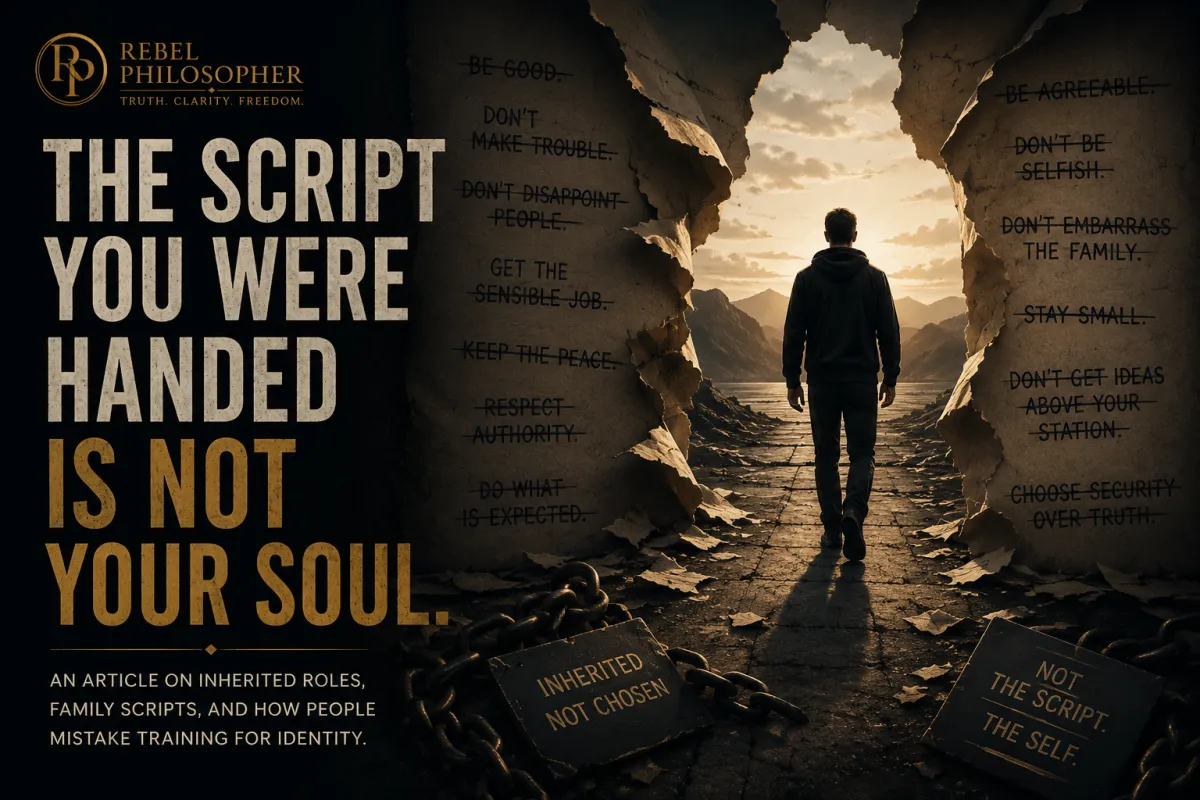
The Script You Were Handed Is Not Your Soul
Before you ever made a serious decision about your life, a lot of decisions had already been made around you.
Not officially. Not with contracts, signatures, or some grand ceremony involving robes and a suspicious gong.
But quietly.
You inherited rules.
You inherited expectations.
You inherited manners.
You inherited fears disguised as wisdom.
You inherited roles that were praised before you were old enough to ask whether they fit.
Be good.
Be agreeable.
Don’t make trouble.
Don’t be selfish.
Don’t disappoint people.
Get the sensible job.
Keep the peace.
Respect authority.
Do what is expected.
Don’t embarrass the family.
Don’t get ideas above your station.
And because these instructions arrived early, they did not feel like instructions.
They felt like identity.
That is how the script gets in.
Not by force at first. By repetition. By praise. By correction. By the warm little glow of approval when you perform the role properly.
You learn which parts of yourself get welcomed and which parts create tension. You learn where the smiles appear. You learn which truths make the room go cold. You learn how to be manageable.
And somewhere along the way, you may mistake being manageable for being good.
That is where the danger begins.
Because the script you were handed may have helped you survive the room you were raised in. But survival scripts are not sacred texts. They are old maps. And not every map deserves to become your country.
1. Family and School Scripts
Most people are trained before they are taught.
Family gives you the first script.
School strengthens it.
Society laminates it and calls it maturity.
In the family system, you are often assigned a role before you understand what a role is. You might become the responsible one, the quiet one, the funny one, the helper, the achiever, the peacekeeper, the rebel, the disappointment, the golden child, the emotional dustbin with legs.
These roles can follow a person for decades.
The responsible child becomes the adult who cannot rest without guilt.
The quiet child becomes the adult who mistakes silence for safety.
The praised achiever becomes the adult terrified of being ordinary.
The family peacekeeper becomes the adult who swallows truth to avoid discomfort.
The rebel becomes the adult who rejects everything before asking whether any of it is actually useful.
Then school adds its own theatre.
Sit still.
Raise your hand.
Ask permission.
Wait to be chosen.
Memorise the approved answer.
Don’t question too much.
Don’t fail publicly.
Move when the bell tells you.
Measure your worth by marks, praise, and whether someone in authority thinks you are “doing well.”
Again, some of this is necessary. A classroom without structure becomes a zoo with worksheets. But training is not neutral. It shapes the nervous system.
You learn to perform.
You learn to comply.
You learn to seek approval from people who may not understand your nature at all.
The problem is not that you were shaped.
Everyone is shaped.
The problem is that many people never inspect the shape.
They simply keep living inside it, calling it personality.
2. Manageability Versus Truth
A lot of people are praised not for being honest, but for being easy to manage.
This is a brutal thing to admit.
The “good” child is often the child who causes the least inconvenience. The “mature” person is often the one who absorbs discomfort without making anyone else uncomfortable. The “reliable” adult is often the one who betrays their own needs quietly and efficiently.
This is how self-abandonment learns to wear a medal.
You become proud of how little you need.
Proud of how much you can tolerate.
Proud of how calmly you disappear.
Proud of how rarely you ask for anything.
And the world rewards this, because the world loves people who are easy to use.
It will call you dependable while draining you.
It will call you strong while ignoring your exhaustion.
It will call you mature when you stop telling the truth.
But manageability is not the same as integrity.
Being low-maintenance is not the same as being whole.
There is a kind of politeness that is really fear. There is a kind of responsibility that is really obedience. There is a kind of loyalty that is really self-erasure with better manners.
At some point, you have to ask:
Am I being kind, or am I afraid of being disliked?
Am I being responsible, or am I avoiding judgment?
Am I keeping the peace, or am I protecting a lie?
Am I mature, or have I just become very skilled at not disturbing the cage?
Truth is rarely convenient.
That is why so many people prefer roles.
A role tells you what to do. Truth asks whether the role should exist at all.
And that question can be terrifying.
Because the moment you question the script, you also question the rewards that came with obeying it.
Approval.
Belonging.
Predictability.
Safety.
The comfort of knowing who you are supposed to be.
But if the cost of belonging is your disappearance, the price is too high.
No applause is worth becoming a ghost in your own life.
3. Why Guilt Guards the Old Role
The old script does not disappear just because you notice it.
It has guards.
The strongest one is guilt.
Guilt often appears the moment you begin moving differently.
You set a boundary and feel cruel.
You say no and feel selfish.
You disappoint someone and feel monstrous.
You choose your own direction and feel ungrateful.
You stop performing the old role and feel as if you have betrayed the entire ancestral line, including people who never paid a bill on time but somehow became moral authorities after death.
This is how inherited obedience survives.
It does not always need external punishment. It lives inside the body as emotional pressure.
You feel bad, so you assume you are doing something wrong.
But guilt is not always a moral signal.
Sometimes guilt is just withdrawal from an old addiction to approval.
If you were trained to be pleasing, honesty will feel aggressive at first.
If you were trained to be quiet, speaking will feel dangerous.
If you were trained to carry everyone, resting will feel irresponsible.
If you were trained to obey, choosing yourself will feel like betrayal.
That does not mean the new action is wrong.
It means the old role is losing control.
This is where most people turn back.
Not because the new life is impossible, but because the emotional weather gets rough.
They confuse guilt with truth.
They confuse discomfort with danger.
They confuse someone else’s disappointment with evidence that they have failed.
But other people’s discomfort is not always proof of your cruelty.
Sometimes it is proof that the old arrangement benefited them.
If someone only loved your obedience, they may call your freedom selfish.
Let them.
A cage will always accuse the open door of being irresponsible.
4. How to Spot Inherited Obedience
Inherited obedience hides in ordinary sentences.
You can spot it by listening to your own justifications.
“I can’t do that.”
“I’m just not that kind of person.”
“My family would never understand.”
“People like me don’t do things like that.”
“I should be grateful.”
“It’s not that bad.”
“I don’t want to cause trouble.”
“I’ll wait until things settle.”
“I have to be realistic.”
Some of these may be true.
Many are inherited locks.
A useful question is:
Who taught me this?
Not who explained it.
Not who benefited from it.
Who taught me to obey it?
Then ask:
Does this rule still serve the life I am trying to build?
That question cuts through a lot of fog.
Because some rules were once protective. They helped you survive a family system, a school system, a class system, a culture, a room where honesty had consequences.
But a rule that once protected you can later imprison you.
The quietness that kept you safe as a child may suffocate you as an adult.
The agreeableness that earned approval may now attract people who exploit you.
The perfectionism that won praise may now keep you from beginning anything real.
The loyalty that made you noble may now keep you tied to people who feed on your guilt.
The goal is not to reject every inherited rule.
That would be childish. Also exhausting. You would become one of those people who thinks having no discipline is a personality.
The goal is inspection.
Keep what is true.
Refuse what is dead.
Rewrite what no longer fits.
This is not rebellion for theatre.
This is sovereignty.
It is the moment you stop treating old instructions as holy simply because they arrived before you had language.
5. The Script Is Not the Soul
The script is loud because it has had years of rehearsal.
The soul is quieter.
It does not usually arrive as a thunderbolt. It arrives as irritation. Longing. Resistance. A strange grief. A private sense that the life you are performing is not the life you are meant to inhabit.
You feel it when you say yes and something inside you folds.
You feel it when you laugh along but know you are betraying yourself.
You feel it when people praise the version of you that is slowly killing you.
You feel it when your life looks fine but requires numbness to continue.
That feeling is not weakness.
It is information.
It is the part of you that was never fully domesticated.
And no, this does not mean you blow up your life in one dramatic afternoon while wearing sunglasses indoors and calling it liberation. Real freedom is usually less theatrical and more disciplined.
You begin by telling the truth somewhere small.
One no.
One honest sentence.
One boundary.
One abandoned obligation.
One decision that belongs to you.
One refusal to keep performing the role because someone else prefers you predictable.
That is how the script loses authority.
Not all at once.
Line by line.
You do not need to become someone else. You need to stop obeying instructions that were never examined.
The script you were handed is not your soul.
It is only the first draft.
And some first drafts need to be cut with a very sharp blade.
So ask yourself:
What rule did you inherit that no longer deserves obedience?
Then do not answer like a philosopher trying to impress a candle.
Answer with your life.
Read The Comfort Trap — and start cutting through the scripts that taught you to call obedience maturity.
https://www.amazon.com/dp/1919297723?spcref=HARDCOVER_LISTING

Pending Reports...
Friction Isn’t a Sign to Stop. It’s the Door Handle.
Due Date June
Friction: Resistance shows up, you interpret it as danger.
Cause: Your nervous system confuses growth with threat.
Cut: Name the sensation (“tight chest”, “buzzing”, “dread”) and proceed anyway—slowly.
Proof: 5 “did it while uneasy” wins recorded.
The Two-Minute Betrayal
Due Date June 2026
Friction: You lose the day in tiny detours.
Cause: Micro-avoidance compounds into macro-failure.
Cut: Before any “quick check”, do one action toward the main task.
Proof: 10 consecutive “first move” wins.
Busy Is Not Productive (It’s Often Just Polite Panic)
Due Date June 2026
Friction: Your calendar looks full; your life looks unchanged.
Cause: Activity soothes anxiety without producing outcomes.
Cut: Choose one measurable weekly outcome and block the work first.
Proof: Outcome completed before Friday each week.
The Identity Trap: ‘That’s Not Me’
Due Date July 2026
Friction: You avoid actions that threaten your self-image.
Cause: The ego protects the story more than the future.
Cut: Act as the person you want to be for 5 minutes. Identity follows behaviour, not speeches.
Proof: A growing list of “I did the thing” evidence.
The Proof-of-Work Life
Due Date July
Friction: You want confidence without receipts.
Cause: You confuse thinking-about-it with building-it.
Cut: Build a “Proof Folder”: screenshots, logs, drafts, reps, shipped links.
Proof: 30 artifacts in 30 days.