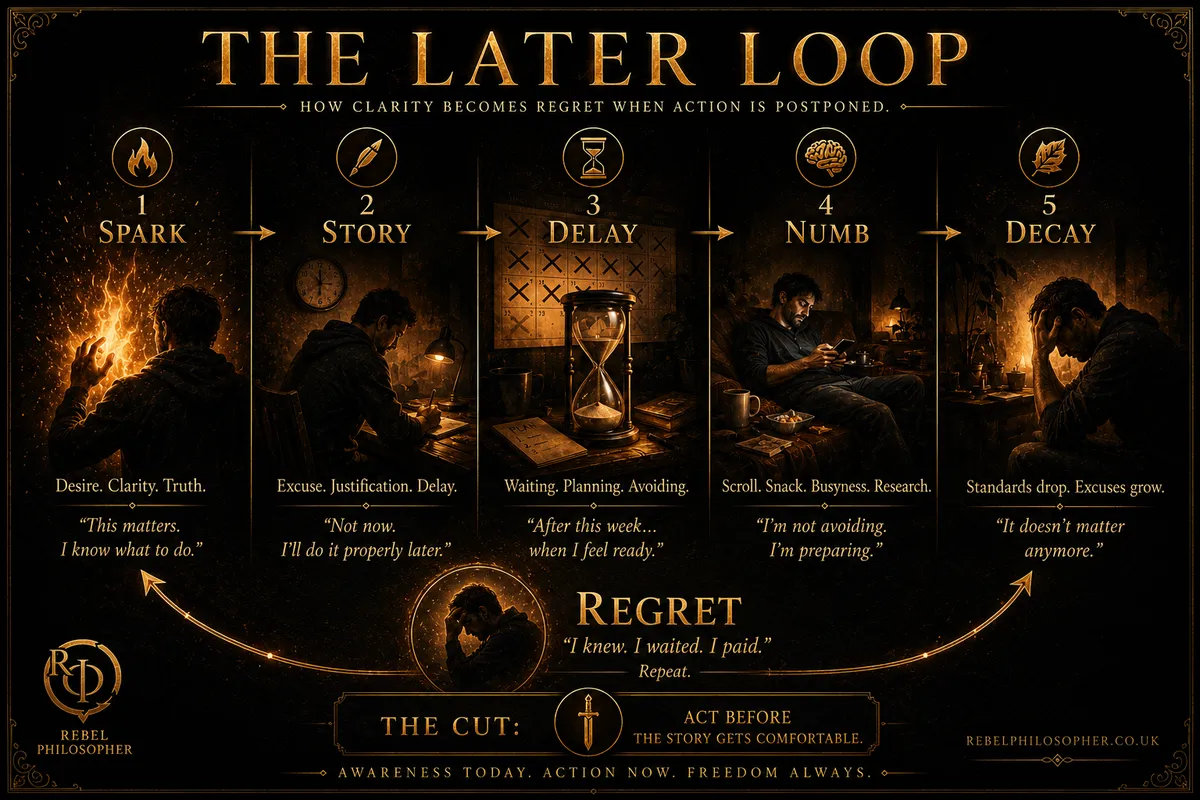
The Later Loop: How a Good Intention Becomes Another Delay
You know the moment.
A clear thought arrives. You should make the call, begin the work, change the habit or finally deal with the thing that has been sitting at the edge of your attention. For a few seconds, the next move feels obvious.
Then another thought appears: not now. You will do it when you have more time, more energy, a better plan or the right frame of mind.
You have not rejected the idea. You have simply moved it to later. That is why the decision feels reasonable.
The Later Loop is the process by which a genuine intention becomes a reassuring story, then a delay, then another source of regret. It rarely announces itself as fear. It sounds thoughtful, responsible and temporary.
A spark creates a moment of truth
The loop begins with a spark. Something in you recognises that the current pattern cannot continue unchanged. The signal may be quiet, but it is honest:
I need to deal with this.
I want to make something real.
I cannot keep postponing this conversation.
I know what the next step is.
The spark matters because it briefly cuts through habit. It brings intention and action close together. You can see the move before the usual explanations arrive.
But the spark is fragile. If it is not converted into contact, the mind has time to protect the existing pattern. It does this by producing a story that makes delay sound intelligent.
The story makes postponement respectable
The story rarely says, “I am afraid to begin.” It offers a better explanation:
I need to think this through properly.
I should wait until I can give it my full attention.
I need more information before I act.
This is important, so I should not rush it.
Any of those statements can be true. That is what makes them effective. The question is not whether the story sounds sensible. The question is whether it produces useful preparation or merely removes you from contact with the task.
A real plan creates a defined next action and a time for doing it. A postponement story creates distance while preserving good intentions. It lets you continue believing that the work matters without asking you to risk an imperfect beginning.
Later is attractive because it protects both comfort and identity. You remain the person who intends to act. You simply avoid the evidence that would show whether your intention can survive reality.
Delay needs somewhere to hide
Once the task has been moved to later, attention must go somewhere else. This is the numbing stage of the loop.
Numbing does not always look idle. It can look productive. You answer messages, reorganise files, refine the plan, watch another explanation or complete several smaller tasks. Activity expands around the one action that would make the intention real.
This is respectable avoidance. It gives you motion without exposure. You can end the day tired and still have no proof that the meaningful work moved.
The short-term reward is relief. The task is no longer pressing directly against you. The cost arrives more slowly. The original clarity weakens, the emotional energy fades and the idea begins to feel less urgent than it did when the spark appeared.
Decay turns delay into regret
An intention that is repeatedly postponed begins to decay. The practical details become harder. The conversation grows heavier. The unfinished task occupies background attention. Your standards may fall simply because you are now trying to recover lost time.
Eventually regret arrives. You ask why the change never happened, why the project still has not begun or why you keep returning to the same promise.
Regret can create a new spark. That is why the loop repeats. Disappointment briefly restores clarity, but clarity without action returns to story, delay and relief.
The full sequence is:
Spark. Story. Delay. Numb. Decay. Regret. Repeat.
The loop is not evidence that you are incapable. It is evidence that your intentions are being asked to survive too much negotiation before they reach behaviour.
Run the 15-minute cut
You do not need to complete the whole task to interrupt the Later Loop. You need to convert the spark into proof before the story takes control.
Use this three-part practice:
Name the story. Write the postponement sentence exactly as it appears. “I need more time.” “I should do this properly.” “I will start when I feel clearer.” Seeing the sentence makes it available for examination.
Build the rough version. Set a timer for 15 minutes and make the smallest real contact with the task. Write the first paragraph. Send the opening message. Create the empty document and add the first three points. Put on your shoes and begin the walk.
Create a receipt. Save the file, log the action, send the draft or note what now exists that did not exist 15 minutes ago. Proof teaches more effectively than another promise.
The work may be clumsy. That is not a failure of the method. A rough beginning is the price of entering reality. The imagined version can remain perfect only because it has not been tested.
The 15-minute cut removes one excuse: that beginning requires a complete solution. It does not. Beginning requires contact.
Make later a time, not a hiding place
Some tasks genuinely should not be done now. The answer is not to treat every impulse as an emergency. The answer is to distinguish scheduling from avoidance.
When you choose later deliberately, give it a date, a time and a first action. Put the commitment somewhere visible. If you are unwilling to schedule it, admit that you are not currently choosing it. That honesty is more useful than carrying another vague promise.
Ask three questions when the fog begins to form:
What feeling am I trying to avoid?
What is the smallest real version of the action?
What proof can I create in 15 minutes?
You do not build self-trust by making more impressive promises. You build it by reducing the distance between a clear decision and visible evidence.
Take the next step
If you want a structured seven-day practice for turning intention into evidence, begin the Self-Trust Sprint.
To understand the broader cycle of trigger, relief and regret, read The Comfort Loop.
If you want a practical tool for putting recurring patterns on paper, get the free Field Manual.
Your life does not change when the future version of you finally feels ready. It changes when the present version of you creates the first receipt.