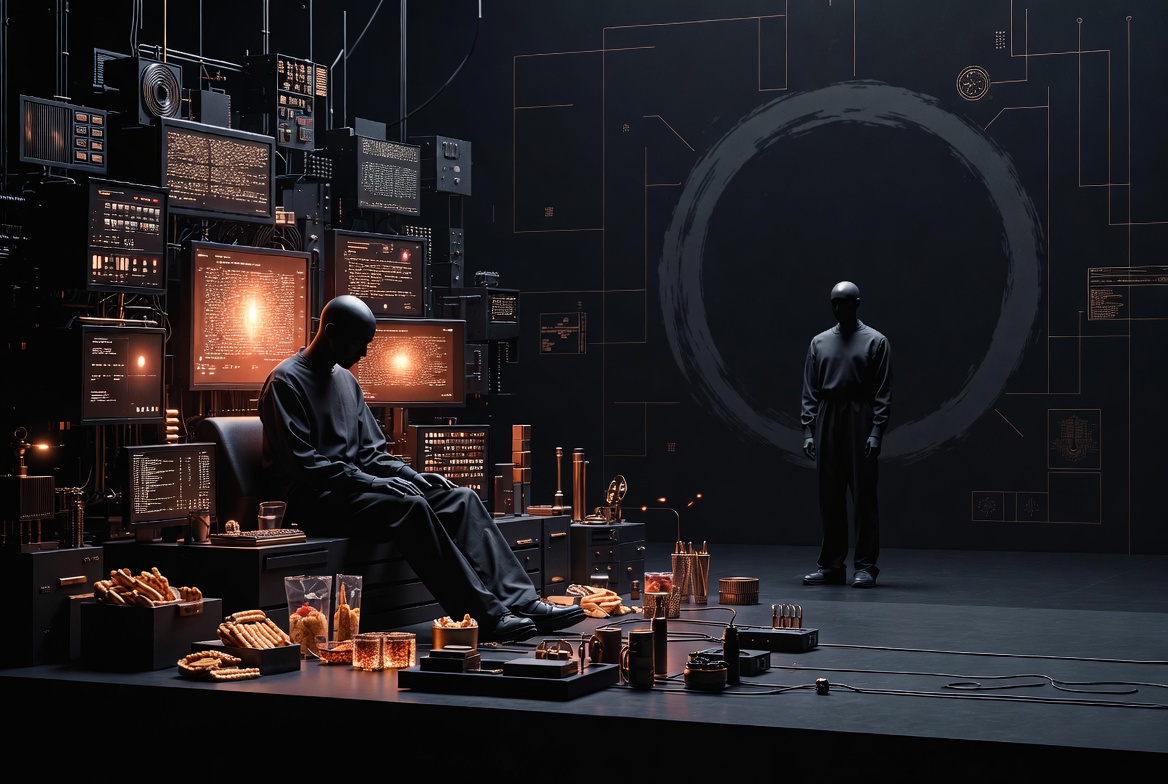
You’re Not Lazy — You’re Well Designed
Laziness is a convenient explanation.
It’s simple. Personal. Final.
If you’re lazy, then the problem is you.
And if the problem is you, there’s not much to examine.
But what if that’s wrong?
The Label That Ends the Investigation
When you call yourself lazy, something subtle happens.
You stop asking better questions.
You don’t look at your environment.
You don’t examine your habits.
You don’t analyse your patterns.
You collapse everything into identity.
“I’m just like this.”
It feels honest.
But it’s not precise.
The System You’re Living Inside
Modern life is not neutral.
It is designed.
Not maliciously.
But intentionally.
Every major system you interact with — your phone, your apps, your entertainment, your food, your work environment — is built to do one thing well:
Reduce friction.
Make things faster. Easier. More accessible. More comfortable.
That’s the goal.
And it works.
What Happens When Friction Disappears
Friction used to be built into life.
You had to move to get what you needed.
You had to wait.
You had to endure small inconveniences constantly.
That friction trained you.
It built patience, focus, and tolerance for effort.
Now it’s gone.
Or at least, dramatically reduced.
And when friction disappears, something else disappears with it:
your exposure to effort.
The Adaptation
The human brain adapts quickly.
Give it constant ease, and it recalibrates.
What used to feel normal begins to feel difficult.
What used to feel difficult begins to feel unnecessary.
This isn’t weakness.
It’s adaptation.
You are responding exactly as a well-designed system would.
The Illusion of Choice
It feels like you’re choosing comfort.
But often, you’re responding to what’s available.
If your environment offers:
endless distraction
immediate rewards
zero resistance
Then choosing discomfort requires something unnatural:
intentional override.
Not because you’re broken.
Because the system is optimised for the opposite.
Why Willpower Feels Unreliable
You try to push through.
For a day. Maybe two.
You remove distractions temporarily. You focus. You act.
Then something pulls you back.
Not dramatically.
Quietly.
You check one thing.
You delay slightly.
You soften the edge.
And the loop resumes.
You interpret this as failure.
But it isn’t.
It’s design beating intention.
The Real Problem
You are trying to build discipline in an environment that erodes it.
You are expecting consistency from a system designed for convenience.
That mismatch creates friction.
And without recognising it, you blame yourself.
The Reframe
Instead of asking:
“What’s wrong with me?”
Ask:
“What is this environment training me to do?”
That question changes everything.
Because now you’re not stuck.
You’re aware.
The First Lever
If you are well-designed, then behaviour follows structure.
Which means:
Change the structure, and behaviour changes.
Not instantly.
But reliably.
Reduce access to distraction.
Increase exposure to effort.
Create small, unavoidable friction.
You don’t need to become stronger overnight.
You need to stop making weakness convenient.
The Quiet Shift
When you remove the label “lazy,” something opens up.
You stop attacking yourself.
You start observing.
You begin to see:
when the loop starts
what triggers it
what reinforces it
And once you see it clearly, you gain something important:
leverage.
What Comes Next
If you are not the problem, and the loop is not random, then the next question is:
What structure is holding this in place?
Because behaviour doesn’t exist in isolation.
It is supported.
By environment.
By energy.
By the stories you tell yourself.
→ Explore: The Friction Triangle
→ Read: The Comfort Loop
→ Try: The Anti-Comfort Protocol
You are not broken.
You are trained.
And anything that has been trained…
can be redesigned.
www.rebelphilosopher.co.uk/comfort-loop
www.rebelphilosopher.co.uk/blog/b/comfort-as-religion
www.rebelphilosopher.co.uk/manifesto
